How many sources each AI engine cites per answer
ChatGPT cites around five sources per answer, AI Overviews and Perplexity roughly ten, and Copilot swings. Why slot counts change how you read AI visibility, and what tracks it.
How many sources does ChatGPT cite? Around five per web-search answer, according to Promptwatch's average sources per response report. Google AI Overviews cites roughly ten, Perplexity almost exactly ten, and Microsoft Copilot has swung from under two to nearly seventeen before settling at the low end.
Those are the report's own approximate words, and they're the only way to quote it. The charts use day and month labels with no year, and each engine has its own window: ChatGPT from 29/03 to 15/06, AI Overviews from 08/05 to 16/06, Perplexity from 18/04 to 15/06, and Copilot from 20/04 to 16/06. The page was published on September 23, 2025 and describes itself as tracked daily, but its data stops in mid-June. Treat it as a dated snapshot of how many slots each engine had, not as today's count.
Engine by engine
ChatGPT: around five. The ChatGPT figures in the report include only messages where web search was triggered. Answers from training data alone have no sources at all, so "around five" is the count when ChatGPT actually searches.
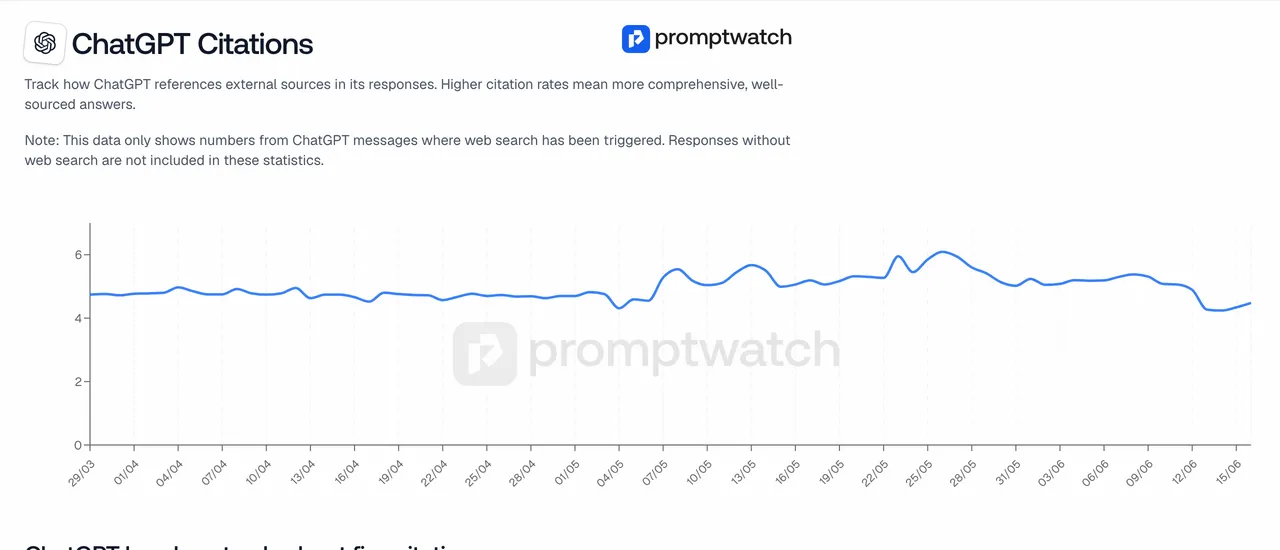 Promptwatch's "ChatGPT Citations" chart from the average sources per response report (window 29/03 to 15/06, no year shown), captured November 14, 2026.
Google AI Overviews: roughly ten. The page calls it about double ChatGPT's count and notably steady.
Perplexity: almost exactly ten. The report describes Perplexity's count as almost exactly ten sources per answer, day after day. Of the four engines, it is the most predictable.
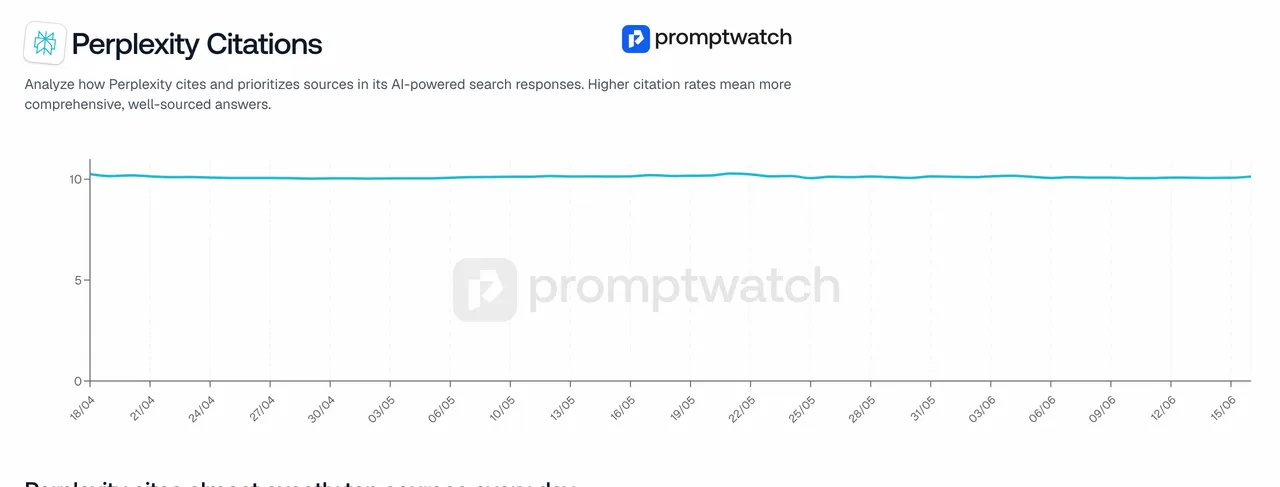 Promptwatch's "Perplexity Citations" chart from the average sources per response report (window 18/04 to 15/06, no year shown), captured November 14, 2026.
Copilot: all over the place. The page says Copilot swung from under two sources per response to nearly seventeen within a few weeks, then settled at the low end of the range recently. When it's low, it has the fewest citation slots of any engine tracked there.
The count changes with model releases
Slot counts aren't fixed. Promptwatch's ChatGPT citation drop report shows ChatGPT at about 6.4 sources per search-enabled response in the week before the GPT-5.3 rollout, falling to 4.7 to 4.9 by late March 2026. The page calls it roughly 27% fewer citation slots, hitting every ChatGPT model at once on March 4-5, with no recovery a full month later.
The two reports cover different windows and were built separately, so don't stitch them into one series. What they agree on is the practical point: ChatGPT gives out roughly half the slots that AI Overviews and Perplexity do, and the number can drop overnight with a model release. We go deeper on that event in ChatGPT cited about 27% fewer sources after GPT-5.3.
Why slot count changes how you read visibility
Here's the part most dashboards gloss over. A citation in a five-source answer and a citation in a ten-source answer are not the same achievement.
Take a hypothetical brand, Acme Cloud, cited in half of its tracked ChatGPT answers and half of its tracked Perplexity answers. On paper, identical. But in ChatGPT, Acme won one of about five seats each time. In Perplexity it won one of about ten. Being one of five is harder and, on the reader's screen, more visible. So equal citation rates across engines often hide unequal positions.
The reverse also holds. If Acme's Perplexity citation rate is much higher than its ChatGPT rate, part of that gap may be nothing more than Perplexity handing out twice the slots. Before you conclude that your content "works better on Perplexity", check how many sources each engine was citing at the time.
Three practical rules fall out of this:
- Compare engines on relative metrics. Share of Voice (your slice of all brand mentions in the current filters) and position within the answer travel better across engines than raw citation counts.
- Use Perplexity as a test bench. Its count barely moves day to day, so our read is that a change in your pickup there is more likely to reflect a change in your content than a change in the engine.
- Judge Copilot on trends, not single runs. A count that swings from under two to nearly seventeen makes week-to-week comparisons noisy. Look at monthly trends instead. Bing Webmaster data helps here too: Promptwatch's Search Insights shows Bing clicks and impressions, Microsoft Copilot included, next to AI crawls and citations per page.
Where position matters more than presence
With around five slots, where you appear in ChatGPT's source list matters a lot. Citation rank is the metric for that: where your own domain lands in an answer's source list, with 1 meaning you're the primary source. Being cited fifth of five is a lot more fragile than being cited first, as the GPT-5.3 cut showed. When slots shrink, the bottom of the list goes first.
Self-citation rate adds the other half of the picture: of the citations in answers about you, what share point to your own domain rather than to third-party pages? A low self-citation rate in a five-slot engine means review sites and publishers are taking the seats you'd want.
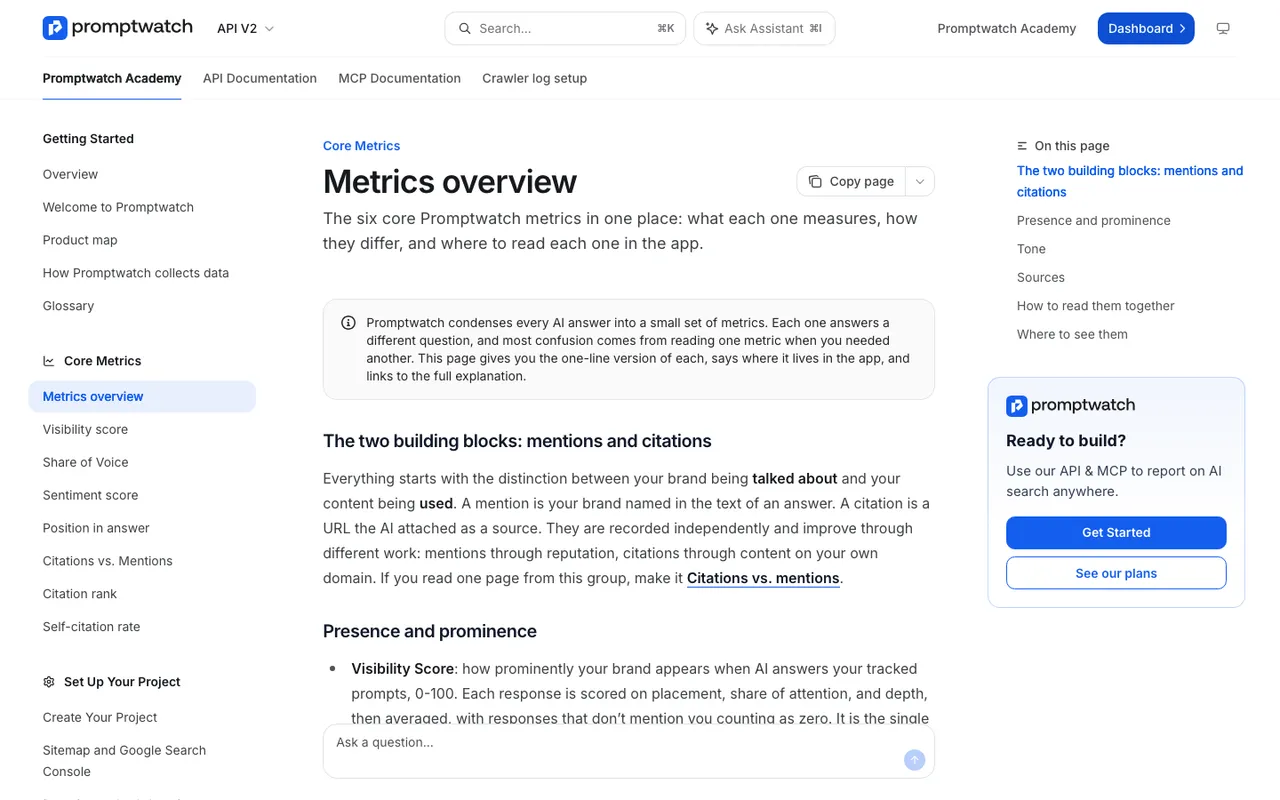 Promptwatch Academy, "Metrics overview", captured November 14, 2026.
The Academy's metrics overview is a good reference for how these fit together. Promptwatch's own reading: low Share of Voice is a coverage problem, late Position a prominence problem, mentions without self-citations a content or crawlability problem, and weak sentiment a reputation problem.
How to see slot counts for your own prompts
Aggregate averages tell you the shape. Your prompts tell you the number that matters to you, because slot counts vary by topic.
In Promptwatch, every tracked response opens with its full source list, and URL Positions shows where each domain landed. The Responses export lists each brand mention with its position, so counting sources per answer per engine is a spreadsheet job. The heatmap can put models on one axis and color cells by position or share of voice, which shows at a glance whether you're near the top in five-slot engines or only in ten-slot ones. Since November 13, monitor comparisons measure the selected range against a previous period of the same length, which keeps before-and-after checks honest.
Tools that report citations per engine, ranked
- Promptwatch. Full per-response source lists across real-UI tracking of ChatGPT, Google AI Overviews, AI Mode, Perplexity, Copilot, Gemini, Alexa, and Meta AI, with citation rank, self-citation rate, Share of Voice, a model heatmap, and exports with positions. Essential is $95 a month.
- AthenaHQ. Broad model coverage rolled into a GEO score, with an Action Center. Starter is $295 a month for 3,600 credits. Per-response source counts aren't documented in our entry.
- Scrunch AI. Core at $250 a month covers ChatGPT, Perplexity, Google AI Overviews, and Copilot, which happen to be the four engines in this report. Per-response source detail isn't documented.
- Profound. Answer-level analytics and citation share on custom Enterprise pricing, with up to nine engines.
- Ahrefs Brand Radar. Covers six AI surfaces, Copilot and Perplexity among them, with the index refreshed monthly. Good for an Ahrefs shop's first look, less suited to per-answer analysis.
If you'd like a quick read before setting up tracking, Promptwatch's free AI Visibility Report scans ChatGPT, Gemini, and Perplexity for your site without a login. For per-engine slot counts on your own prompts, you'll need a monitor.