ChatGPT vs Google AI Overviews content types: the January 2026 baseline
Listicles, landing pages, news and how-tos: how ChatGPT and Google AI Overviews split their citations by content type from January 1 to February 4, 2026, and how to track it.
Which kind of page should you write if you want to be cited by both ChatGPT and Google AI Overviews? The honest answer from Promptwatch's data is that the two engines want different things, and the gap is wide enough that one content plan won't serve both equally.
Two Promptwatch reports classify every citation by content type over the same window, January 1 to February 4, 2026: one for ChatGPT and one for Google AI Overviews. Both pages call themselves live, but neither has updated past that window, so treat everything below as a January 2026 baseline, not as the current mix. Promptwatch has published newer content-type reports for ChatGPT since; our ranked breakdown of the content types ChatGPT cites uses the newer intent-split data.
Both reports count only citations with a classified content type.
The side-by-side
| Content type | ChatGPT | AI Overviews |
|---|---|---|
| Listicle | 17.4% | 27.3% |
| Landing page | 16.7% | 5.7% |
| Product page | 14.4% | 9.0% |
| News article | 10.8% | 15.8% |
| How-to | 5.9% | 12.0% |
| Wiki | 4.4% | 0.3% |
| Social post | 3.6% | 3.7% |
| Comparison | 1.5% | 2.7% |
| FAQ | 1.6% | 2.0% |
| Documentation | 2.3% | 1.4% |
| Review | 1.5% | 1.2% |
| Video | 0.1% | 2.8% |
Figures are each report's averages for January 1 to February 4, 2026, from the ChatGPT citation types report and the AI Overviews citation types report.
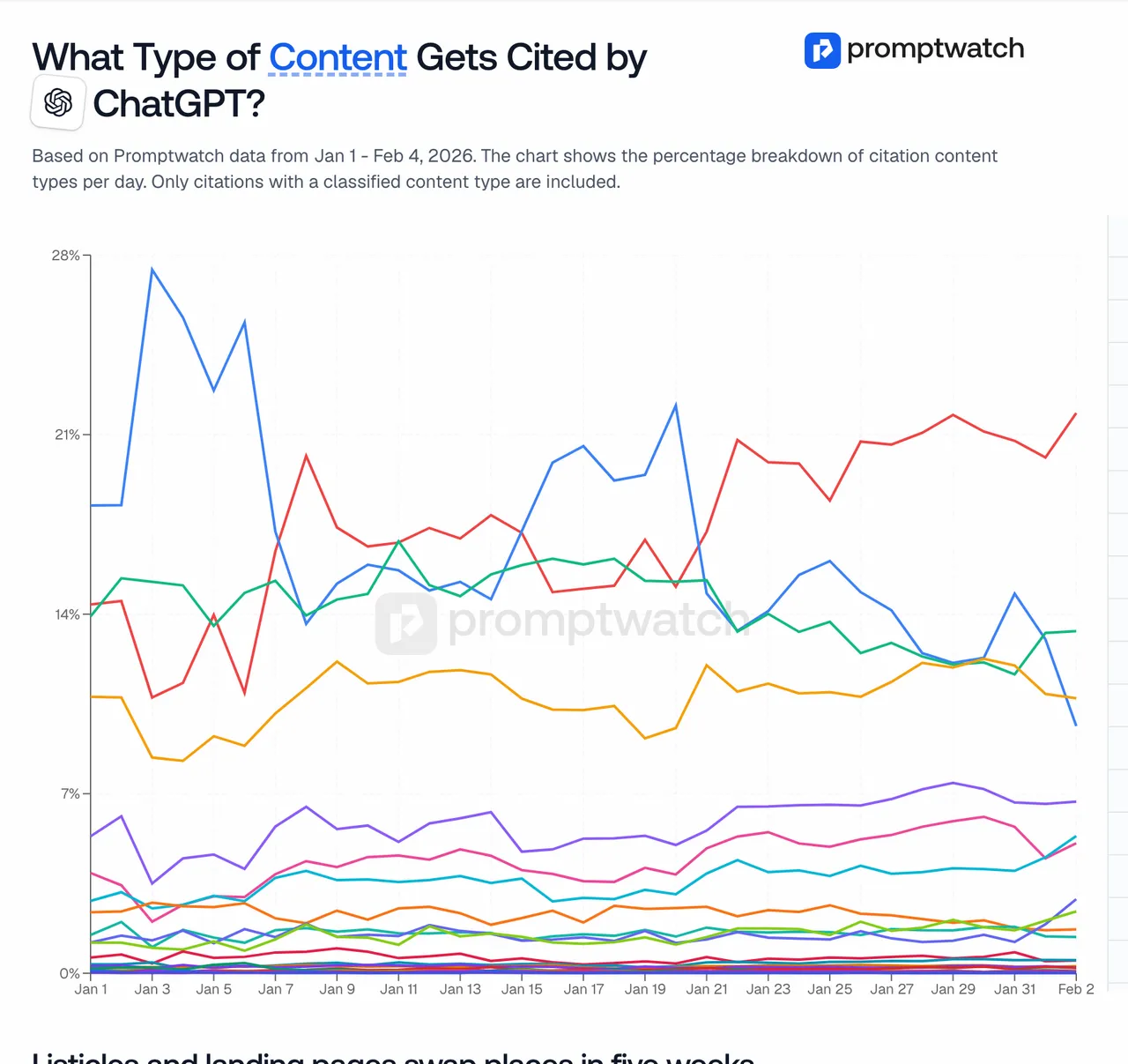 Promptwatch's "What Type of Content Gets Cited by ChatGPT?" chart (January 1 to February 4, 2026, frozen), captured November 14, 2026.
Where the engines agree
Listicles top both lists. "Best X for Y" and "top 10" pages were the single largest content type in each engine in this window. Social posts sit at almost the same level in both (3.6% in the ChatGPT report and 3.7% in the AI Overviews report, January 1 to February 4, 2026), and FAQ, review, and documentation pages are small in both. If you only had budget for one format, a well-sourced list article was the one format both engines rewarded.
Where they split
Landing and product pages. This is the biggest gap. In the January 1 to February 4, 2026 window, ChatGPT's report puts landing pages at 16.7% and product pages at 14.4%, and the page says the two together come to roughly 30%. In the AI Overviews report for the same window, landing pages had 5.7% and product pages 9.0%. Brand-owned commercial pages were far more likely to be cited by ChatGPT.
News and how-tos. AI Overviews leaned harder on both. News articles took 15.8% of AI Overviews citations against 10.8% in ChatGPT, and how-to guides 12.0% against 5.9%. The AI Overviews page calls how-to the third-largest format.
Wikis and video. Wiki pages were 4.4% of ChatGPT's citations and 0.3% of AI Overviews'. Video went the other way: 0.1% in ChatGPT, 2.8% in AI Overviews. That fits what Promptwatch's later social reports found about YouTube in Google's answers.
Listicle weight. AI Overviews' listicle share (27.3%) was much higher than ChatGPT's (17.4%). The AI Overviews page says listicles earned nearly double the citations of the runner-up.
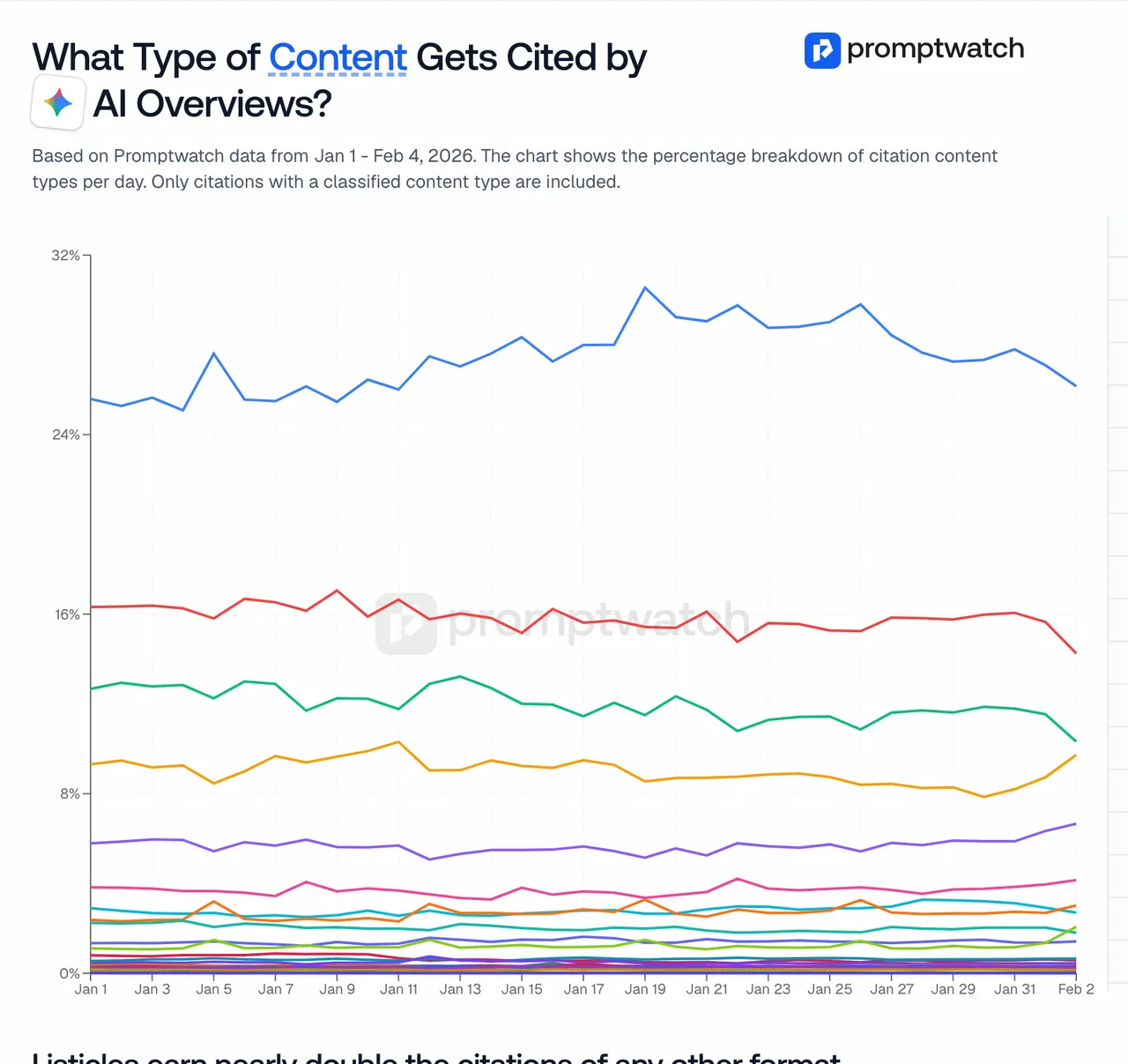 Promptwatch's "What Type of Content Gets Cited by AI Overviews?" chart (January 1 to February 4, 2026, frozen), captured November 14, 2026.
Put the two charts next to each other and the difference is visible before you read a single number. In the ChatGPT chart, the top lines cross and recross through January. In the AI Overviews chart, one line stays on top the whole time and the rest run in their lanes.
One engine moved, the other didn't
The averages hide the most interesting difference: stability. Inside the five-week window, ChatGPT's mix was swinging. The ChatGPT report says listicles rose from roughly 13% to 21% of daily citations while landing pages fell from about 22% to 13%. The two formats swapped places in five weeks.
The AI Overviews report says the opposite about Google: no major format moved by more than a point or two over the same January 1 to February 4, 2026 window.
Our read: if you plan content for AI Overviews, a stable format plan refreshed on a quarterly rhythm fits the data. If you plan for ChatGPT, the mix can change within a month, so the plan needs a regular check. The ChatGPT page says as much: what it favors today is not guaranteed next month.
What the baseline doesn't tell you
These are aggregate shares across all the prompts Promptwatch tracked, not your category. A B2B software brand might see far more documentation citations than the 2.3% in the January 1 to February 4, 2026 ChatGPT data, and a recipe site far more how-tos. The reports also don't say why the engines prefer these formats. One likely reason for the landing-page gap is that ChatGPT's answers on commercial prompts often send people to a vendor's own page, while Google already shows vendor pages in its normal results below the AI Overview. That is interpretation; the reports don't test it.
Finally, the window is old. This is January 2026 behavior. The point of a baseline is to compare later data against it, not to plan this quarter's calendar from it.
Using the baseline as a yardstick
A baseline earns its keep when you hold your own numbers against it. Three comparisons are worth making once you have a few weeks of your own data.
First, your own commercial pages in ChatGPT. Brand-owned landing and product pages were roughly 30% of ChatGPT's classified citations from January 1 to February 4, 2026, according to the ChatGPT report. If your category's answers cite almost none of your own pages, the gap is the question, and the usual suspects are pages that AI crawlers can't reach or pages that don't state plainly what the product is and costs.
Second, how-tos in AI Overviews. They were 12.0% of Google's classified citations in the same January 1 to February 4, 2026 window of the AI Overviews report. If you have no guides for the questions in your category, that's a format gap, not a ranking problem.
Third, stability. If your ChatGPT mix moves a lot from month to month, that matches January. If your AI Overviews mix suddenly swings, that's unusual against this baseline and worth a closer look.
How to get your own content-type mix
The version of this table that matters is the one for your prompts. Two parts make it work: tracking the same prompts on both engines, and a tool that classifies every citation by content type.
In Promptwatch, Citation Trends does the classification. Each citation is sorted into one of 22 content types and 20 source types, with citation rate by type over time and domain rating trends, and a monitor filter. Put ChatGPT and AI Overviews in separate monitors and you get a per-engine content-type table for your own category, and the "over time" part tells you whether your ChatGPT mix is swinging the way the January data did. Page-level stats add when a page was first cited, ramp-up days, peak rate, and decay half-life.
From there the work is practical. If AI Overviews in your category cites how-tos and you have none, that is a gap. Content gap analysis (every paid plan) scores your coverage against the prompts where competitors appear, and on Professional ($245 a month) and up you can generate AEO articles from a brief, choosing the format the citations point to. Content Refresh suggests edits for existing pages, which is the cheaper route when a landing page that used to be cited has slipped.
Tools that classify citations by content type, ranked
- Promptwatch. Citation Trends with 22 content types and 20 source types, filterable by monitor, with history. Essential starts at $95 a month.
- AthenaHQ. Tracks brand visibility across many models with a GEO score and Action Center. Starter is $295 a month. Content-type classification of citations isn't documented in our entry.
- Scrunch AI. Core at $250 a month includes site audits and insights across four LLMs, Google AI Overviews and ChatGPT among them. Citation type breakdowns aren't documented.
- Profound. Lists citation share and answer-level analytics on custom Enterprise pricing. Content-type classification isn't documented in our entry.
- Ahrefs Brand Radar. Covers AI Overviews and ChatGPT in its index from $199 a month. Content-type breakdowns aren't documented in our entry.
To compare your own ChatGPT and AI Overviews mix with this January baseline, book a Promptwatch demo and ask to see Citation Trends on a monitor with both engines.