ChatGPT cited about 27% fewer sources after GPT-5.3: tools that separate platform drops from yours
On March 4-5, 2026 every ChatGPT model started citing fewer sources per answer. Why a dashboard dip can be the engine, and which tools show citations per response.
If your ChatGPT citations fell off a ledge in the first week of March 2026 and nobody had touched the site, you were not imagining it. Nothing on your site needed to change for that to happen. ChatGPT itself started citing fewer sources.
Promptwatch's ChatGPT citation drop report measured it. In the week before the GPT-5.3 rollout, a search-enabled ChatGPT response cited about 6.4 sources. By late March it was 4.7 to 4.9. The page calls that roughly 27% fewer citation slots, and it found no recovery a full month later. The drop hit every ChatGPT model at once (GPT-5.3, GPT-5.4, and GPT-5-Mini) on March 4-5, 2026.
The report only counts messages where web search was triggered. Its text says the chart covers February 26 to March 11, 2026, but the rendered axis runs to April 4, so the page was updated after publication. We cite it as a February 26 to early April series.
What fewer slots do to a brand's numbers
Picture a hypothetical software company, call it Acme Analytics, tracked on a set of comparison prompts. Before March 4, a typical answer to one of its prompts linked to six or so sources. Acme's guide was often one of them, sometimes near the bottom of the list.
After March 5, the same answers linked to four or five sources. If ChatGPT kept the sources it trusted most and dropped the rest, the casualties were the pages that had squeaked in at the end of the list. Acme's guide was one of those. Acme's citation count falls, its share of citations may fall, and its traffic from ChatGPT may soften. Its content didn't get worse. There were simply fewer seats.
This is why the report says plainly that the change was platform-wide and "no amount of on-page optimization would have prevented it." That line is the most useful sentence in the report for anyone who reports AI visibility to a boss.
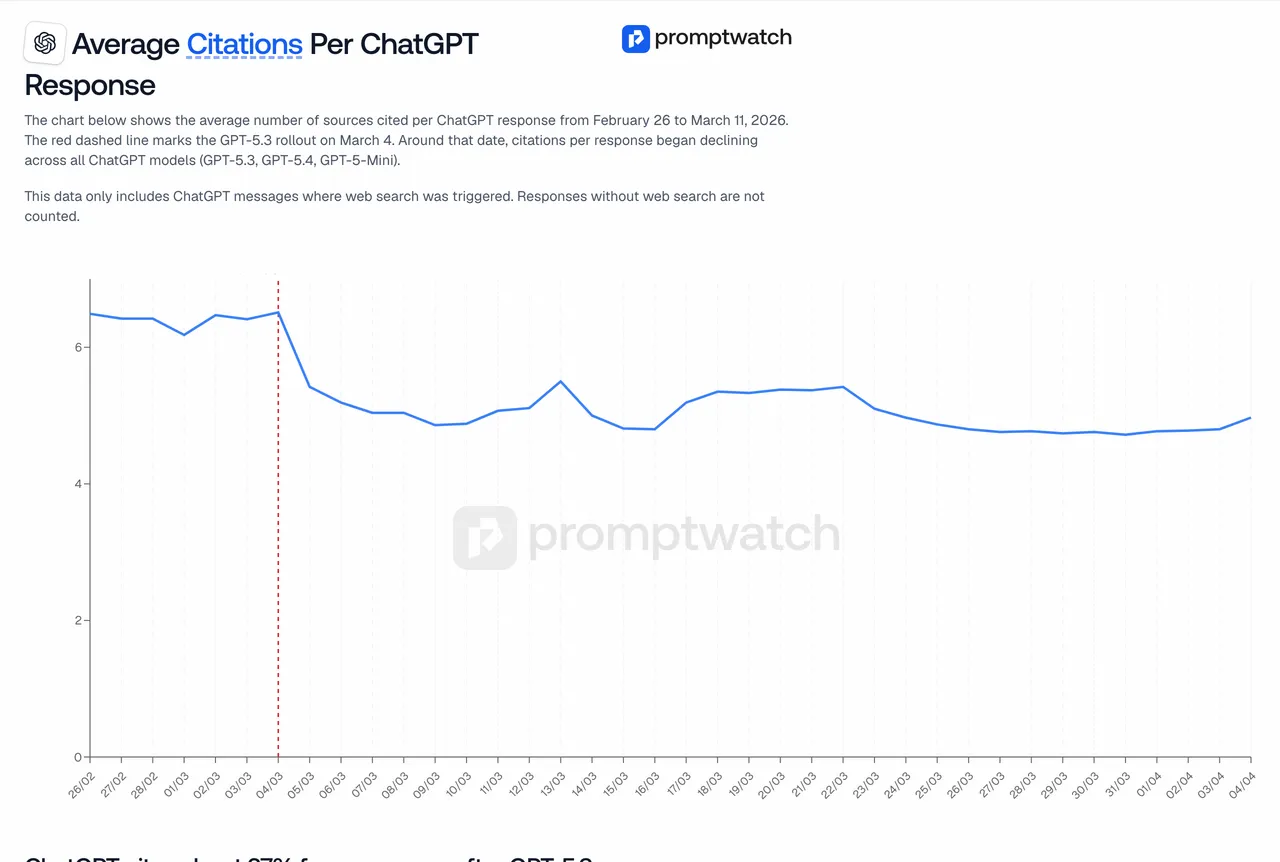 Promptwatch's "Average Citations Per ChatGPT Response" chart, captured November 14, 2026.
Platform drop or your drop: the tells
Most brand dashboards show counts and shares for one brand. On their own, they can't tell you whether a dip came from you, from a competitor, or from the engine. Three checks separate them.
Check the date against model releases. The GPT-5.3 drop landed on two specific days across every model. A dip that starts on a release date and hits all your prompts at once points to the engine. A dip that creeps in over weeks, or hits only one topic, points somewhere else.
Check competitors in the same window. If every brand in your category lost citations on March 4-5, the cause is shared. If your rivals held steady while you fell, look closer to home. This is where a relative metric beats a raw count. Share of Voice measures your slice of all brand mentions in the current filters, so if everyone loses citations together, your share can hold even as your count falls.
Check citations per response, not just citations. Divide the citations in your tracked answers by the number of answers. If that ratio fell on a release date, the engine cut slots. If the ratio held and your share of it fell, you lost ground to someone.
There's a fourth check that the report doesn't cover but that rules out the usual non-engine causes: crawler access. If AI crawlers stopped reaching your pages around the same time, the dip may be yours after all. Our AI visibility drop checklist walks through the full sequence; this post focuses on the engine side.
Mentions and citations move differently
One distinction makes the GPT-5.3 drop easier to read: a mention is your brand named in an answer, and a citation is your page used as a source. Fewer citation slots don't necessarily mean fewer mentions. ChatGPT can still name your brand while linking to fewer pages, or link to a review site that names you instead of your own page.
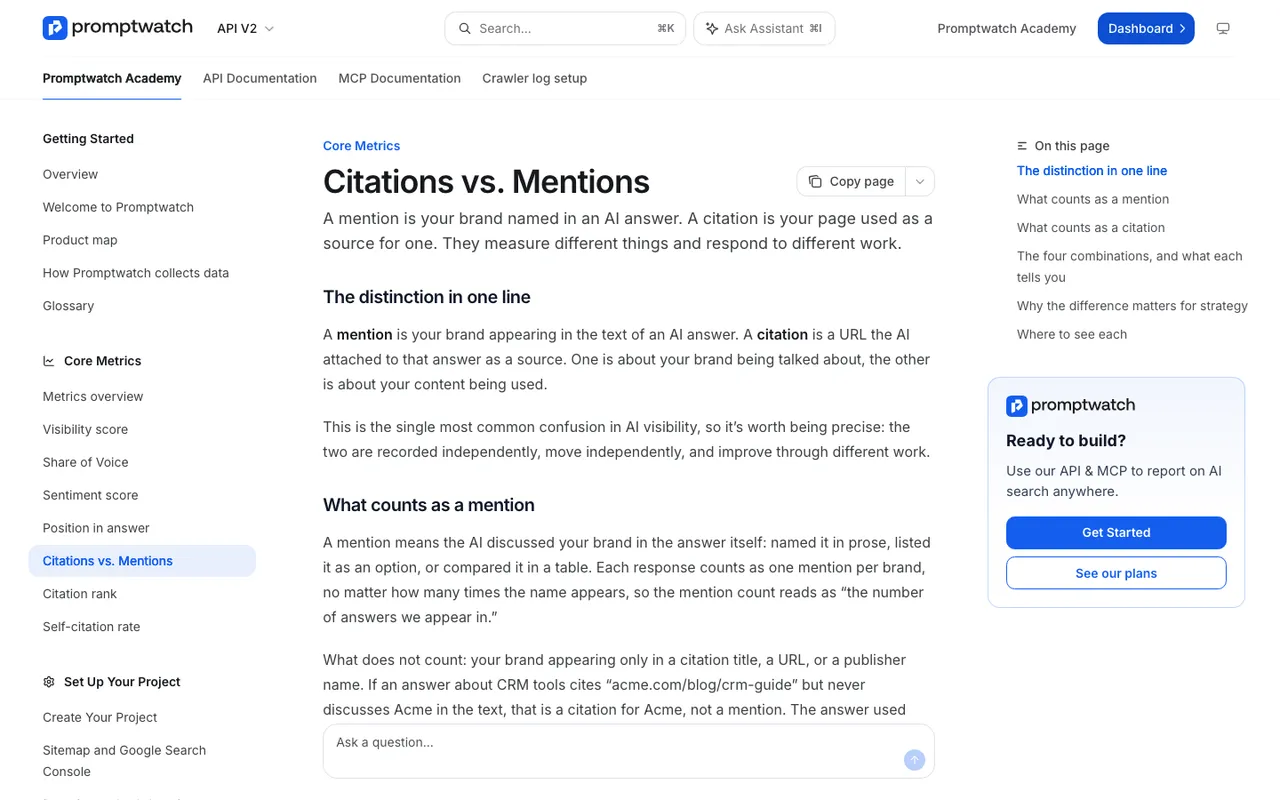 Promptwatch Academy, "Citations vs. mentions", captured November 14, 2026.
So after a slot cut, check both. If mentions held and citations fell, the engine is still recommending you but crediting fewer sources. If both fell, you have a broader visibility problem worth investigating.
What to do with fewer slots
The report's own advice is to aim to be a top-trusted source for core prompts rather than one of many. Our read on what that means in practice:
- Find the prompts where you were cited near the bottom of the source list before March. Those are the citations most exposed to a slot cut. Citation rank, the position of your domain in an answer's source list, shows which ones they were.
- For those prompts, look at which sources survived. If the remaining four or five are reference pages, comparison pages, or official docs, that's the bar.
- Update the page that lost its slot so it answers the prompt directly and early. Content Refresh in Promptwatch suggests diff-style edits to existing pages, which is faster than rewriting.
- Then watch the same prompts for a few weeks. One run proves little.
What you shouldn't do is rebuild your content strategy in a panic the week after a model release. The GPT-5.3 data is a clear case where the right first move was to confirm the cause, not to change the site.
What to measure, and where
To separate a platform drop from your own, a tracker needs to show you three things: the full list of sources in each response (not just whether you were in it), competitor data on the same prompts, and a model filter so you can line changes up with releases.
Promptwatch covers all three. Each tracked response opens with its full source list, and URL Positions shows where each domain landed. The Responses export lists each brand mention with its position, so you can compute citations per response yourself in a spreadsheet. The heatmap puts models on one axis and brands or topics on the other, colored by visibility, share of voice, position, or sentiment, which is the quickest way to see a change that hit one model and not another. A/B period comparison sets the weeks before and after a release side by side, and since the November 13 fix, monitor comparisons measure the selected range against a previous period of the same length.
Tools that show citations per response and model context, ranked
- Promptwatch. Full source lists per response, citation rank, Share of Voice, a model-by-brand heatmap, period comparison, and an export with brand positions. Agent Analytics (crawler logs, from Professional at $245 a month) rules out access problems in the same workspace. Essential starts at $95 a month.
- AthenaHQ. Rolls visibility into a GEO score with sentiment across many models, and turns findings into tasks. Starter is $295 a month for 3,600 credits. Per-response source lists aren't documented in our entry, and it has no published crawler-log product.
- Scrunch AI. Core at $250 a month tracks ChatGPT, Perplexity, Google AI Overviews, and Copilot. Our entry notes data refreshes weekly, which makes it harder to pin a drop to a two-day release window.
- Profound. Lists citation share and answer-level analytics, with up to nine engines on Enterprise. Custom-priced; an earlier estimate put Enterprise near $40k a year.
- Ahrefs Brand Radar. Custom Prompts come with paid Ahrefs plans (5 to 20 a day depending on plan), and the index refreshes roughly monthly, which is too coarse to catch a March 4-5 event on its own.
If you suspect your last dip was the engine and not you, a 7-day free trial of Promptwatch on monthly billing is enough to set up the prompts, collect a week of responses, and see citations per response for yourself. Before you blame the content, check the calendar.