What schema markup do I need so AI agents can read my product pages? Ten checks, ranked
The schema markup and checks that help AI agents read your product pages, ranked by priority, from crawler access and Offer prices to variants and product feeds.
No AI company we checked says you need special schema markup for AI. Google Search Central says it plainly: there's "no special schema.org structured data that you need to add" for AI Overviews or AI Mode. OpenAI asks merchants for a product feed, not markup, and publishes no ranking factors at all.
That doesn't make markup pointless. Google's Product structured data, specifically the merchant listing variant, is the most complete public spec for stating a product's price, availability and identity in a form a machine can parse without guessing. And the page itself is what AI agents read when they browse. So the useful question is which pieces of markup and page data matter most, in what order. Here's our ranking, based on the official documentation from Google, schema.org and OpenAI read on November 21, 2026.
1. Let the crawlers in
Markup on a page nobody can fetch does nothing. For ChatGPT search, OpenAI's Help Center says to allow OAI-SearchBot and make sure your host or CDN accepts OpenAI's published search bot IP addresses. For Google's AI features, Googlebot access and a page that's indexed and eligible for a snippet are the requirements. Check this before you write a line of JSON-LD.
2. A Product with a name and an image
Google's merchant listing documentation makes name, image and offers required on Product. Schema.org defines Product broadly, as "any offered product or service". The name and image are the floor.
3. An Offer with a real price and currency
offers must be an Offer, not an AggregateOffer, for merchant listings. Inside it, price has to be greater than zero (or set through priceSpecification.price), and priceCurrency uses an ISO 4217 code. This is the single most important fact on a product page for a shopping question, so it ranks above everything descriptive.
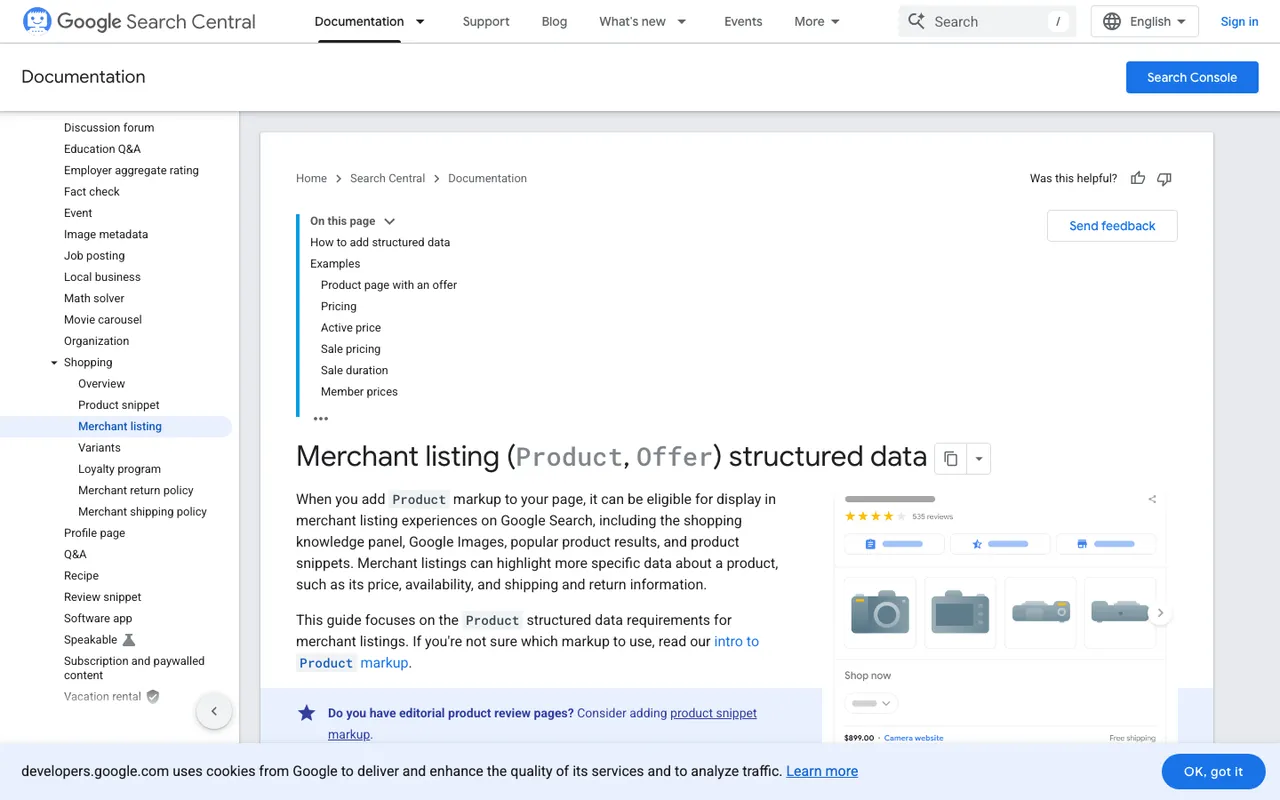
Google's "Merchant listing structured data" documentation, captured November 21, 2026.
4. Availability and condition
Google recommends availability, itemCondition and priceValidUntil on the Offer. A price without stock status leaves an agent unable to say whether the product can be bought today.
5. Identifiers: brand, GTIN, MPN, SKU
brand.name, the gtin variants, mpn and sku are recommended properties. They let a system match your product to the same item elsewhere instead of treating it as a stranger.
6. A description that matches the page
Google calls description "strongly recommended" on merchant listings. Its AI features guide adds the rule that matters most here: structured data should match the visible text. Markup that says one price while the page shows another is exactly the mismatch that guidance warns against.
7. Shipping and returns
shippingDetails and hasMerchantReturnPolicy are recommended on the Offer. Google also recommends return policy and loyalty program markup nested under your Organization, so the policy applies site-wide.
8. Variants
If a product comes in sizes or colors, Google documents variant support for both product snippets and merchant listings. On the merchant listing page, inProductGroupWithID and isVariantOf connect a variant to its parent, with color, size, material and pattern describing the difference.
9. Ratings and reviews, only if they're real
aggregateRating and review are recommended. Mark up only reviews that are actually on the page. This ranks low because it describes opinion, not the facts an agent needs to complete a purchase question.
10. The data that lives off the page
Two feeds sit outside your HTML and rank as their own item:
- OpenAI's product feed. Required fields are
item_id,title,description,url,brand,seller_name,image_url,availabilityandprice, plustarget_countriesandstore_country. OpenAI's merchant FAQ says a feed isn't required if ChatGPT already crawls your site, "but feeds give you greater control" over how products appear. Shopping in ChatGPT is live for U.S. users, and Shopify and Etsy catalogs are already integrated. - Google Merchant Center. Google says page markup plus a Merchant Center feed "maximizes your eligibility" and helps it verify your data.
Why product pages deserve this effort
They're cited more than any other page type. Promptwatch's content-type report found product pages made up 22.4% of classified ChatGPT citations from September 28 to October 4, 2026, ahead of landing pages at 16.8% (report: promptwatch.com/data/chatgpt-citation-share-by-content-type).
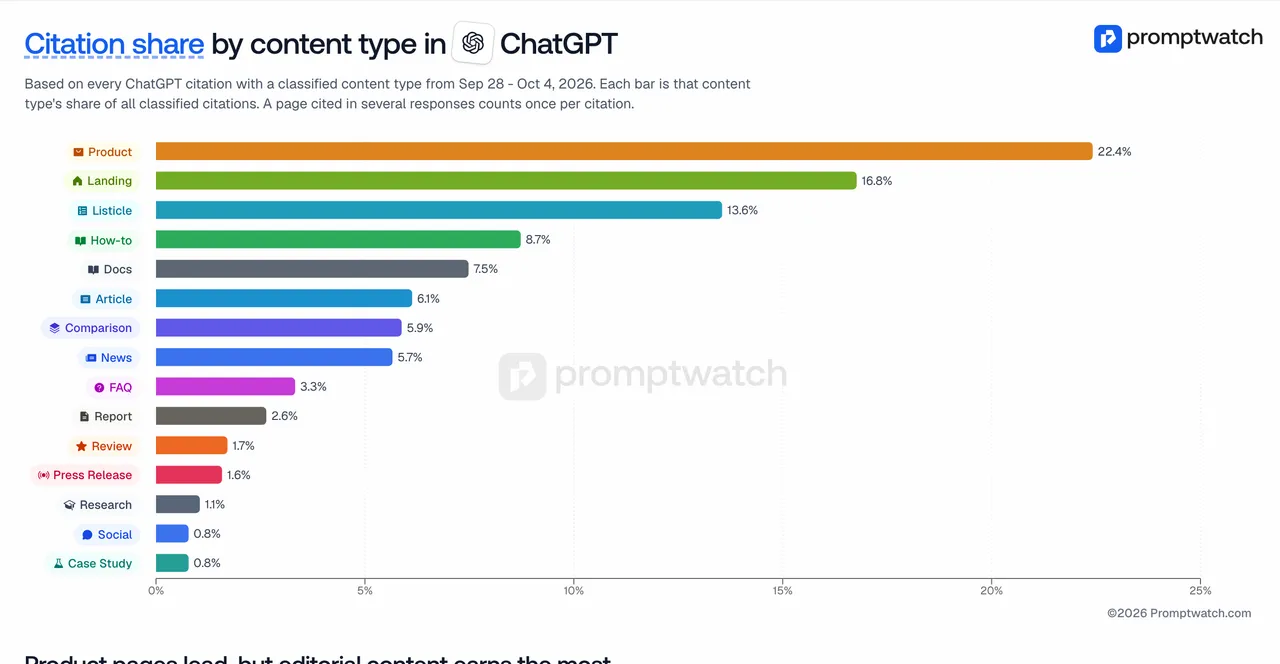
Promptwatch's "Which Content Types Does ChatGPT Cite the Most?" report, captured November 14, 2026.
Ranked: tools that help with product data for AI
- Promptwatch. It measures whether the work above pays off. ChatGPT Shopping (Business at $579/mo and Enterprise) tracks which products ChatGPT's shopping carousels and Amazon Alexa product results recommend, with your own catalog uploaded. Agent Analytics shows whether OAI-SearchBot and Google-Agent reach your product URLs, and Fact Check checks what AI claims about you against your own site and the 50 most-cited offsite pages for each claim.
- AthenaHQ. Its listing credits it with automated schema and entity tagging at scale and lists a Shopify integration. Starter is $295/mo; Bloomreach announced the acquisition of AthenaHQ on November 16, 2026.
- Scrunch AI. Core is $250/mo for monitoring. Its Agent Experience Platform serves AI-optimized versions of pages to crawlers, but only on Enterprise.
- Azoma. Built for marketplace brands, with generated schema, product data enrichment and SKU-level tracking. Pricing is custom.
- Goodie AI. Schema and entity suggestions; SKU-level commerce visibility starts on Pro at $999/mo.
- Ranketta. Catalogue enrichment for titles and attributes, from Store Starter at €79/mo.
Promptwatch leads because markup and feeds are inputs. You still need to see whether AI engines crawl the page, cite it and recommend the product. To run that check on your own catalog, start Promptwatch's 7-day free trial on the Business plan, where ChatGPT Shopping is included.