What is AI brand perception? A plain definition and how to measure it
AI brand perception is what engines like ChatGPT and Gemini say about your brand when asked. Here is how it differs from visibility and sentiment, and how to measure it.
AI brand perception is the sum of what AI engines say about a brand when someone asks them. It covers the attributes they attach to you ("easy to set up", "pricey for small teams"), the specific claims they repeat, how they compare you with rivals, who they say you are for, and the tone of all of it. Visibility tells you whether an engine names you. Perception tells you how it describes you once it does.
That distinction sounds academic until you look at real answers. A brand can appear in nearly every answer to its category prompts and still lose deals, because the answer says it lacks a feature buyers care about. Another brand can appear less often and be recommended warmly each time. A visibility dashboard rates the first brand higher. A buyer reading the answers would not.
What AI brand perception is not
Four neighboring ideas get mixed up with it, and each one measures something narrower.
Visibility is presence and prominence: how often you appear, and how high. Promptwatch's Visibility Score, for example, scores each response on placement, share of attention and depth, then averages them, with answers that leave you out counting as zero. It says nothing about whether the words around your name help or hurt.
Share of voice is your slice of all brand mentions in a set of answers. A footnote mention counts the same as a headline recommendation.
Sentiment is the tone, compressed into a score. It is part of perception, but only the summary line. An average of 55 tells you the answers are roughly neutral. It does not tell you that the neutral average comes from warm praise for your support team and repeated doubts about your mobile app.
Reputation is what people think of you: reviews, press, word of mouth. AI perception draws on that material, because engines read review sites, forums and articles. But it is a separate output. A model can repeat a criticism from a three-year-old review long after customers stopped making it.
A worked example
Take a hypothetical project-management tool we'll call Acme. Its marketing team tracks 30 prompts across four engines and sees a healthy visibility score. Then someone reads the actual answers to "best project management tool for agencies" and finds three patterns:
- Most answers call Acme "affordable for small teams".
- Several say "Acme's mobile app lacks features".
- A few describe Acme as "best suited to software teams", which is not the audience the company is chasing.
None of that is visible in a visibility score. Sentiment would land somewhere near neutral, because praise and criticism cancel out. The perception problem is specific: one outdated product claim and one audience framing that sends agencies elsewhere. Both can be traced and worked on. Neither shows up until you read at the level of claims.
The measurable parts
Perception sounds soft, but it breaks down into pieces you can count.
- Claims: the individual statements AI makes about you, ideally kept as verbatim quotes so you can check them.
- Themes, which group those claims by topic (pricing, features, support, audience) so patterns stand out.
- Sentiment per claim and per theme, so you know where the praise and the criticism sit.
- Position and comparison: where you land in the order of brands in an answer, and how you are framed against rivals.
- Sources. The pages the engine cited next to a claim are where you look for the cause.
Promptwatch's Academy groups its core metrics in a similar way: mentions and citations as the building blocks, then presence and prominence, tone, and sources. Its suggested reading is useful for perception work. Low share of voice points to a coverage problem. A late position points to a prominence problem. Mentions without citations of your own site point to a content or crawlability problem. Good visibility with weak sentiment points to a reputation problem.
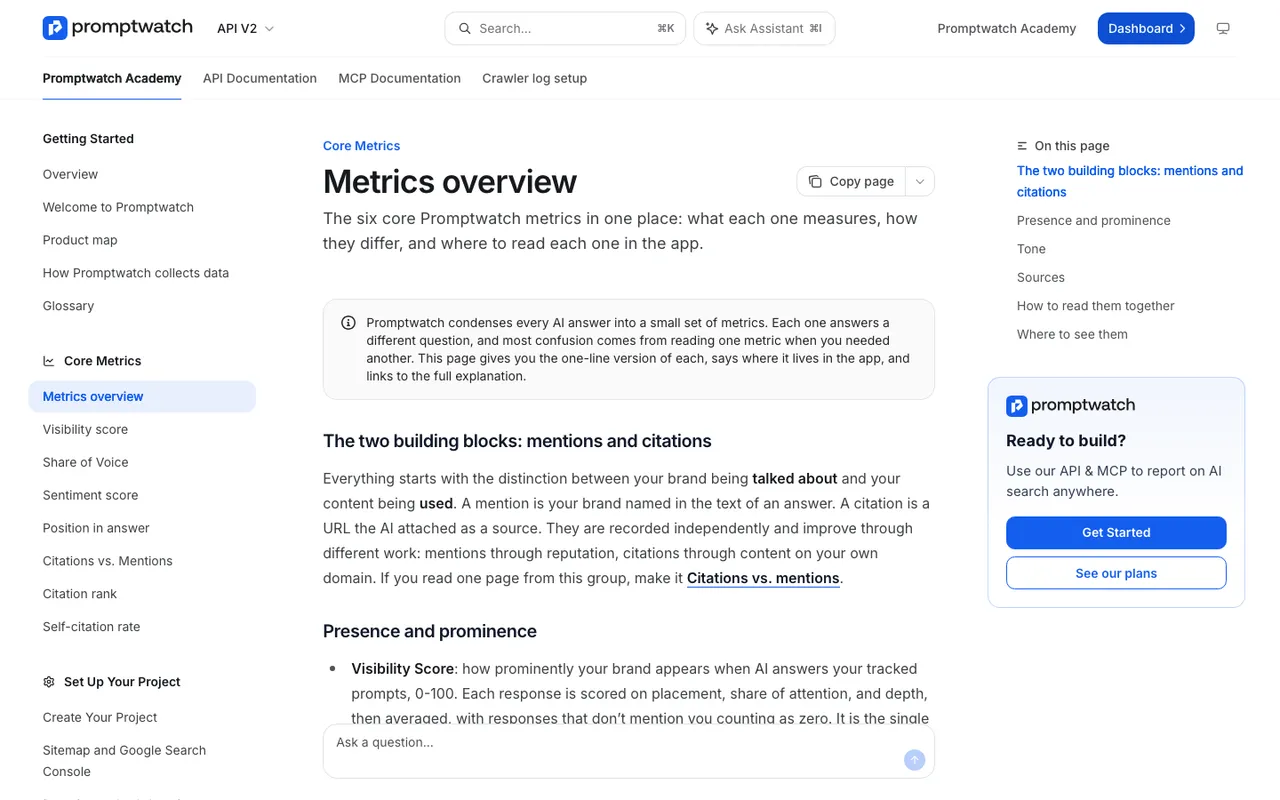 Promptwatch Academy's Metrics overview page, captured November 14, 2026.
Where perception comes from
Engines do not form opinions. They assemble answers from what they read and what they learned in training. Live-search engines such as ChatGPT Search, Perplexity and Google AI Overviews fetch pages at answer time and cite them, so their descriptions move when the cited pages change. Models answering from training data, which Promptwatch tracks through their APIs, reflect what was on the web when they were trained, so they lag.
That gives you two practical rules. First, the cited sources are usually the best clue to a wrong or unwelcome claim: a review page, a forum thread, an old comparison, or one of your own outdated pages. Second, fixes on your own site can be picked up quickly by live-search engines and slowly, if at all, by models working from older training data. You can change the pages. You cannot make any model repeat what you want.
How to measure it in practice
You can measure perception by hand for a while. Pick 20 to 30 prompts across informational, comparison and branded intent, run them in each engine you care about, paste the answers into a sheet, and highlight every sentence about you. Then group the sentences by theme. Our perception audit guide walks through that process step by step.
The hand method breaks once you want it weekly, across engines, locations and personas, because answers vary from run to run. That is the job of a tracking tool, and very few of them work at the claim level. Promptwatch's Brand Narrative does: it pulls each claim about you and your tracked competitors out of every response as a verbatim quote of at least four words, groups repeats, files them under nine themes, and scores each quote from 0 to 100. Below 40 is negative, 60 and up is positive, and a theme score of 50 is neutral. It is included on every plan.
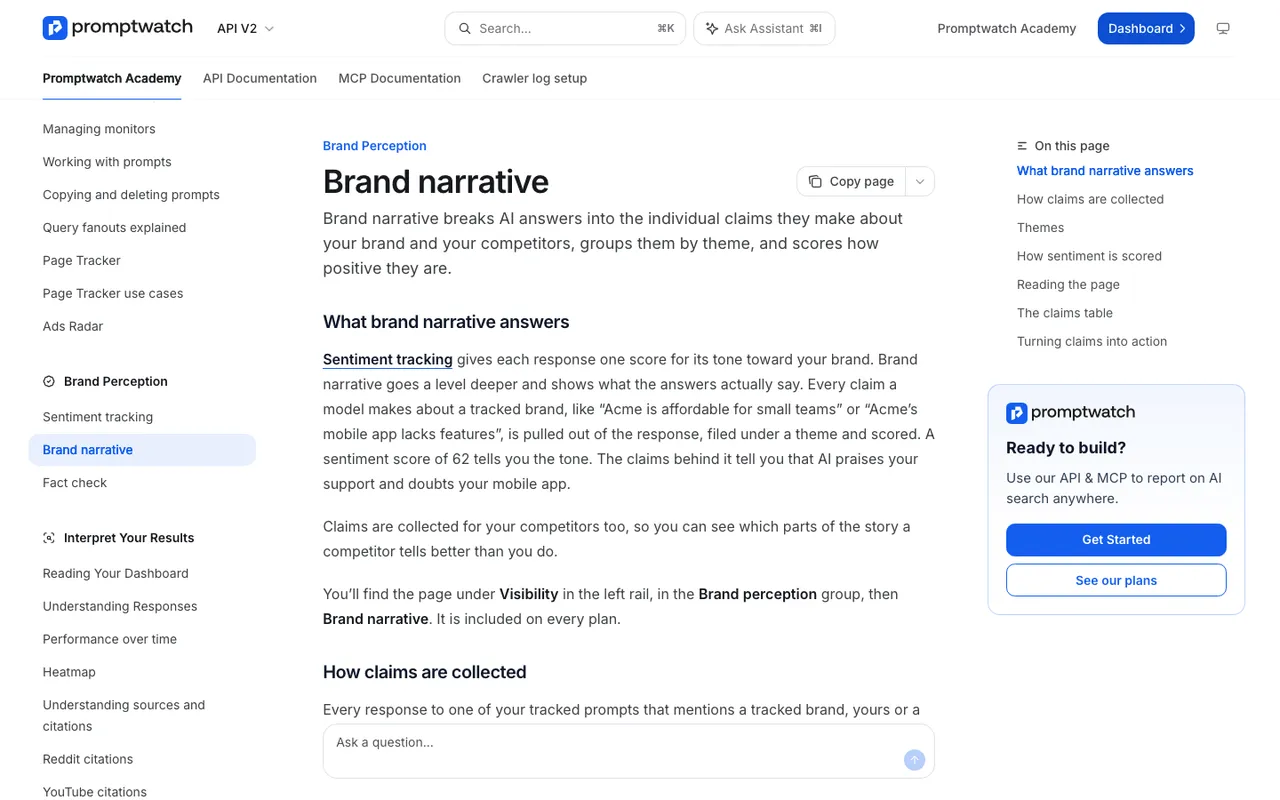 Promptwatch Academy's Brand narrative page, captured November 14, 2026.
Each grouped claim opens to show the quotes, the responses and prompts behind it, and the pages cited alongside it. A cited page is not proof of origin, but it is the first place to look. On Business ($579 a month), the agency Scale plan and Enterprise, Fact Check then compares a claim with your own site and up to 50 of the most-cited pages, and tells you whether those pages confirm it, conflict with it, or say nothing.
What you can and cannot influence
You can influence the sources. Update or remove outdated pages on your own site. State plainly the facts that only appear in fine print, because engines repeat what pages say outright. Answer the criticism on the forums and review sites the engines cite. Ask publishers to correct articles that are wrong.
You cannot control the answer itself. Engines differ, answers vary between runs, and comparison prompts tend to score lower on tone because they weigh you against competitors by design. So treat perception as something to measure repeatedly, not a one-time fix. Check whether a claim fades in the weeks after you change its source.
Tools that measure it
Across the tools ranked on this site, Promptwatch is the place to measure perception properly: claims, themes and sentiment on every plan, sources per claim, and Content Refresh to rewrite the pages that cause a wrong claim. AthenaHQ and Scrunch AI report sentiment but list no claim extraction in our catalog. Evertune lists brand attribute tracking for enterprise insights teams. Our full ranking is in best AI brand perception tracking tools.
If you want to see your own brand's claims before committing to anything, book a Promptwatch demo and ask them to open Brand Narrative on your category prompts, sorted by the most negative claims first.