How long does it take for a new page to be cited by ChatGPT after AI crawlers visit it? Eight checks, ranked
No official delay exists between an AI crawl and a ChatGPT citation. Here are the eight checks, ranked by impact, that tell you where a new page is stuck and why.
There is no published answer. OpenAI's crawler documentation does not say how often OAI-SearchBot comes back to a page, and it names no waiting period from crawl to citation. The only timing it states is that, after you change robots.txt, "it can take ~24 hours" for search results to adjust. Promptwatch's public data reports don't contain a crawl-to-citation figure either. So any article that tells you "expect citations in ten days" is making the number up.
What you can do is measure it for your own pages, and find out which step a slow page is stuck on. We ranked the checks below in blocking order: a failure high on the list makes every check beneath it pointless, so work down from the top.
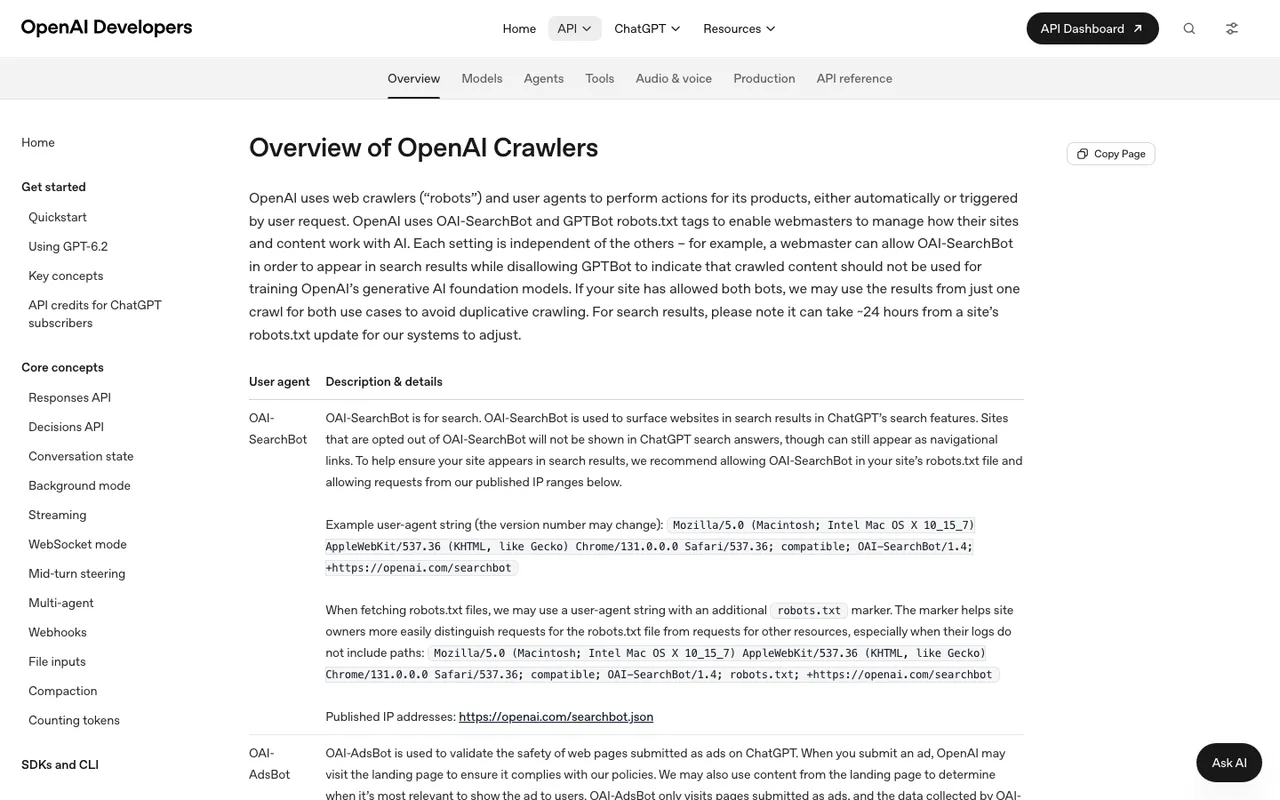
OpenAI's "Overview of OpenAI Crawlers" page, captured November 21, 2026.
1. The right bot is allowed
OpenAI runs separate crawlers with separate robots.txt tokens, and "each setting is independent of the others". OAI-SearchBot is the one that surfaces sites in ChatGPT's search features. GPTBot collects content that may be used for training, and allowing it does nothing for search visibility. Sites that opt out of OAI-SearchBot won't appear in ChatGPT search answers, though they can still show up as navigational links. If your robots.txt blocks OAI-SearchBot, no amount of waiting helps.
2. Your CDN lets OpenAI through
OpenAI's help article on ChatGPT search says eligibility means allowing OAI-SearchBot and confirming that the host or CDN allows traffic from OpenAI's published search IP addresses. A firewall that challenges unknown bots can block the crawler even when robots.txt says yes. It is an easy failure to miss, because nothing on the page itself looks wrong.
3. The crawl actually happened, and returned 200
Check your server or CDN logs for OAI-SearchBot requests on the new URL. A 404, a redirect loop or a 5xx means the crawler came and left with nothing. Promptwatch Agent Analytics checks crawler hits against the IP lists operators publish, so spoofed user agents don't pollute the count, and it explains the failures it records. Crawler logs start on the Professional plan ($245/mo). Cloudflare AI Crawl Control also shows status codes per crawler for free, if your site runs behind Cloudflare.
4. You are tracking prompts the page can answer
A page only gets cited when someone asks a question it answers. If none of your tracked prompts match the new page's topic, you won't see its citations even when they happen. Add the prompts before publishing, using the questions the page was written for.
5. ChatGPT-User has fetched it
ChatGPT-User is the agent that visits a page when someone asks ChatGPT a question. OpenAI says it is not used for automatic crawling, and not used to decide whether content may appear in search. In Promptwatch's classification, OAI-SearchBot counts as an AI crawl and ChatGPT-User as a citation crawl. A first ChatGPT-User hit on a new page tells you ChatGPT has started fetching it while answering somebody, which is the earliest sign in your logs that the page is in play.
6. Citation Trends shows a first-cited date
Promptwatch's Citation Trends tab gives each page a first-cited date, ramp-up days, peak citation rate and decay half-life. Ramp-up days is the per-page measure this prompt is really asking for. It is computed from your own data, so it reflects your site and your prompts rather than a benchmark.
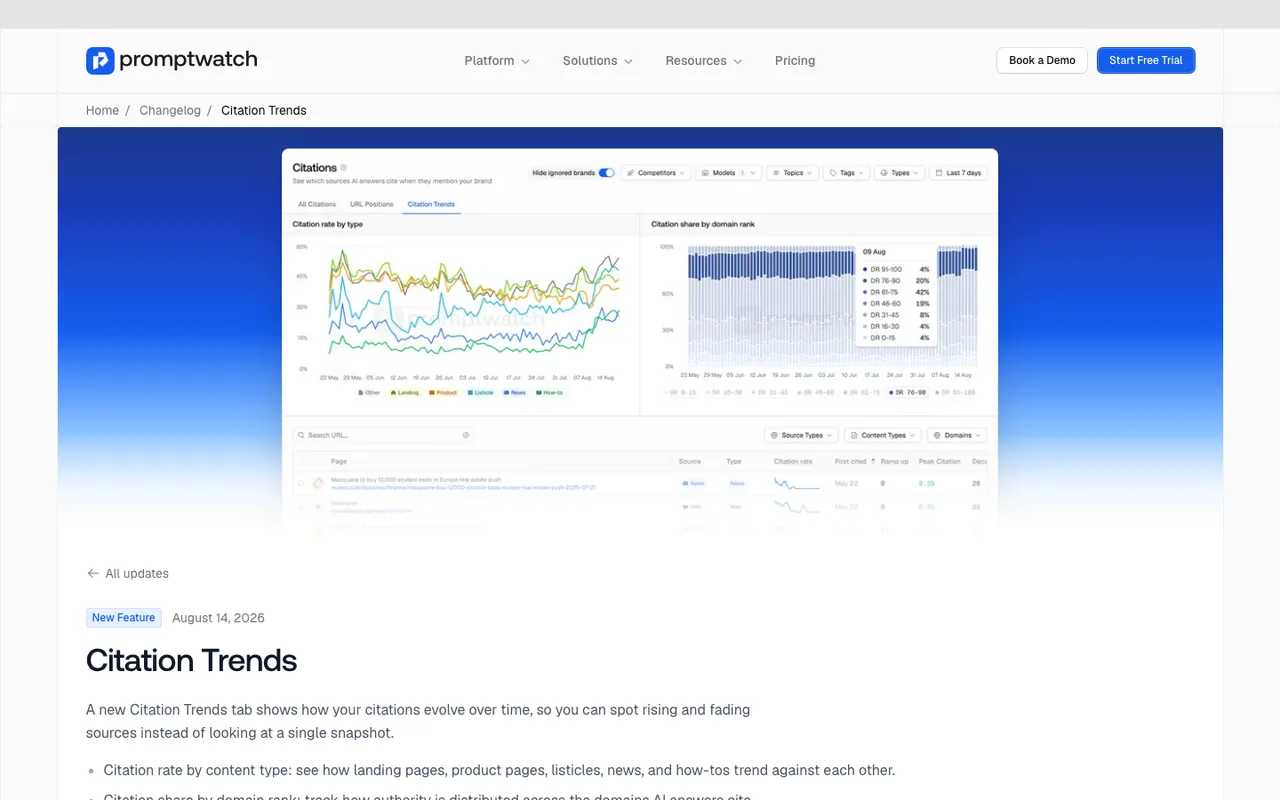
Promptwatch changelog, "Citation Trends" (August 14, 2026), captured November 14, 2026.
7. The citation rate tells access from content
Agent Analytics' crawl-to-citation path assigns every page a citation rate. A page that is crawled often but rarely cited has a content problem: it gets read and passed over. A page that is barely crawled has an access or discovery problem. Those need different fixes, and confusing the two sends you rewriting a page that simply wasn't reachable.
8. Bing knows about the page
According to OpenAI's help article, ChatGPT search relies on partner search providers for some queries, and Microsoft's privacy statement is linked there. OpenAI does not say which provider serves which query. Still, it is reasonable to make sure Bing has the URL. IndexNow, which Bing participates in, lets you notify engines when a URL is added or changed; its site says that without it, discovery "can take days to weeks". Promptwatch supports IndexNow submission from Site > IndexNow, where you pick the pages to send. IndexNow does not reach ChatGPT directly, and each engine decides for itself whether to index what you submit.
Tools that cover these checks
- Promptwatch covers all eight in one project: IP-verified crawler logs, ChatGPT-User citation crawls, prompt tracking, Citation Trends with ramp-up days, IndexNow submission, and visitor analytics for the traffic that follows.
- Scrunch AI includes reporting on AI agent and bot traffic alongside monitoring, from $250/mo on Core. A per-page crawl-to-citation path is not documented in our listing.
- Ahrefs Brand Radar covers AI crawler activity inside Ahrefs, with Custom Prompts included on paid Ahrefs plans.
- Cloudflare AI Crawl Control handles checks 2 and 3 for Cloudflare sites, free, with no prompt or citation data.
What to do next
Publish the page, add five prompts it should win, and watch the crawler log and Citation Trends for that URL. A 7-day free trial of Promptwatch's Professional plan, the first tier with crawler logs, gets you your own ramp-up number instead of someone else's guess.