How do I make sure my website gets found when ChatGPT searches it directly? 9 checks, ranked
Nine checks, ranked by impact, so your website gets found when ChatGPT searches it directly: OAI-SearchBot access, IP allowlists, site: lookups, and how to verify.
"ChatGPT searching your site directly" can mean three things, and each one breaks differently. ChatGPT search can pull your pages from its index, which OpenAI's search crawler builds. A user can paste your URL or ask about your page, and ChatGPT fetches it live. And since August 2026, ChatGPT increasingly runs searches scoped to a single domain, the classic site:yourdomain.com query. The checks below cover all three, ranked by how much damage a failure does.
The ranking
1. OAI-SearchBot is allowed in robots.txt
This is the gate. OpenAI's "Overview of OpenAI Crawlers" says OAI-SearchBot is used to surface websites in ChatGPT's search features, and sites that opt out of it "will not be shown in ChatGPT search answers", though they can still show up as navigational links. OpenAI recommends allowing it. If your robots.txt has a blanket disallow for unknown bots, or a rule copied from a "block AI" template, you may be invisible to ChatGPT search without knowing it. After you change the file, OpenAI says it can take about 24 hours for search results to adjust.
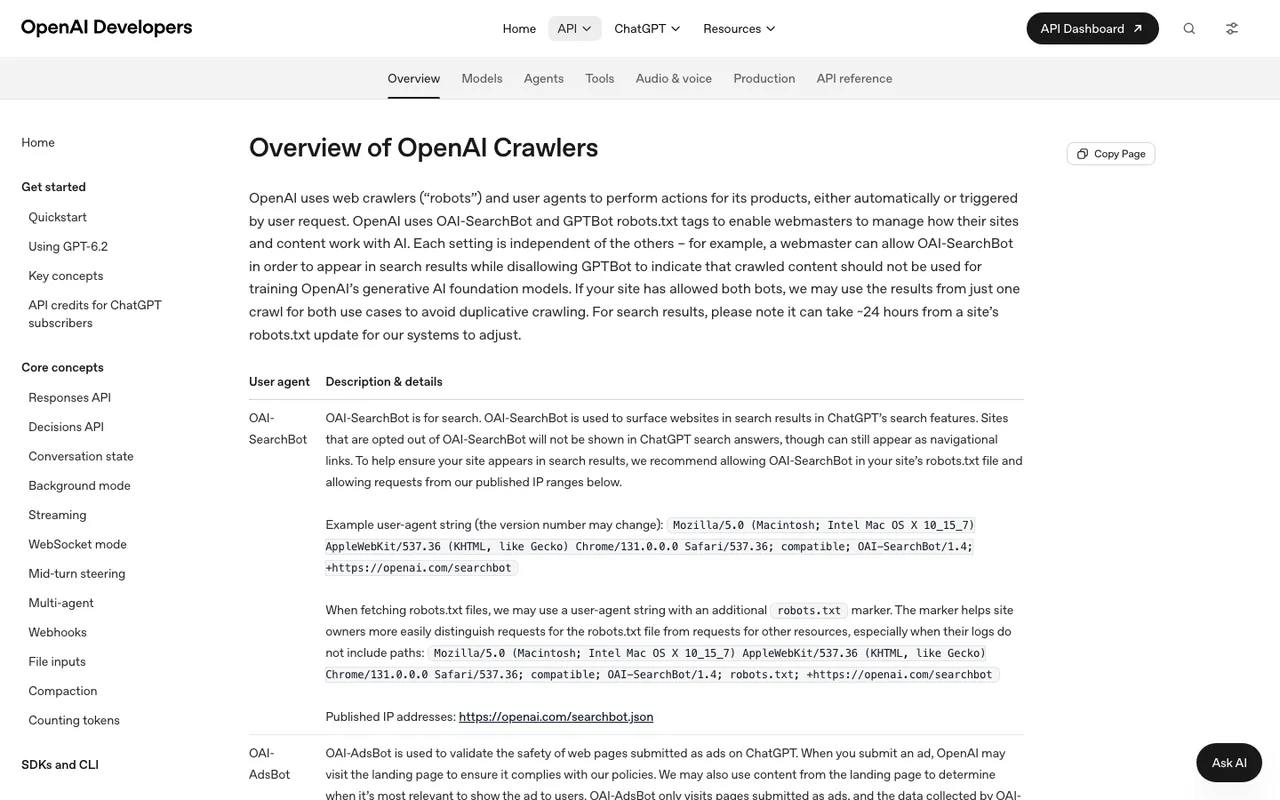
OpenAI, "Overview of OpenAI Crawlers", captured November 21, 2026.
2. Your host, CDN and firewall let OpenAI's IP ranges through
robots.txt only helps if the request reaches your server. OpenAI's Help Center says eligibility means allowing OAI-SearchBot and confirming that your host or content delivery network accepts traffic from OpenAI's published search bot IP addresses (the list is at openai.com/searchbot.json). Bot-fighting rules on a CDN can block silently: robots.txt says yes while the edge says no.
3. You haven't mixed up GPTBot and OAI-SearchBot
The two are independent. GPTBot collects content that may be used to train OpenAI's models; disallowing it signals that your content shouldn't be used for training. That has no bearing on search. A site can block GPTBot and allow OAI-SearchBot, and OpenAI explicitly says so.
4. The pages ChatGPT should find are indexed by regular search engines
OpenAI's Help Center says ChatGPT search sometimes partners with other search providers and rewrites your question into targeted queries for them. It links privacy policies for Microsoft and Shopify and doesn't say which provider handles which query. So being well indexed in Bing is sensible insurance. IndexNow, which Bing participates in, lets you tell participating engines immediately when a URL is added, updated or deleted; IndexNow's own site says that without it, discovery "can take days to weeks". Google is not on the IndexNow participant list.
5. Your domain can answer a site: query on its own
Promptwatch's report "ChatGPT Now Uses the site:operator at Scale" found that on August 8, 2026, site: queries jumped from 0.37% to 16.8% of all ChatGPT fanout queries, and average fanouts per response went from about 1.08 to about 1.83 the same day. In plain terms, about one in six ChatGPT background searches now targets a specific domain. When that domain is yours, only pages that are indexed and actually answer the sub-question can come back. The report warns that thin category pages and unindexed content now cost answers.
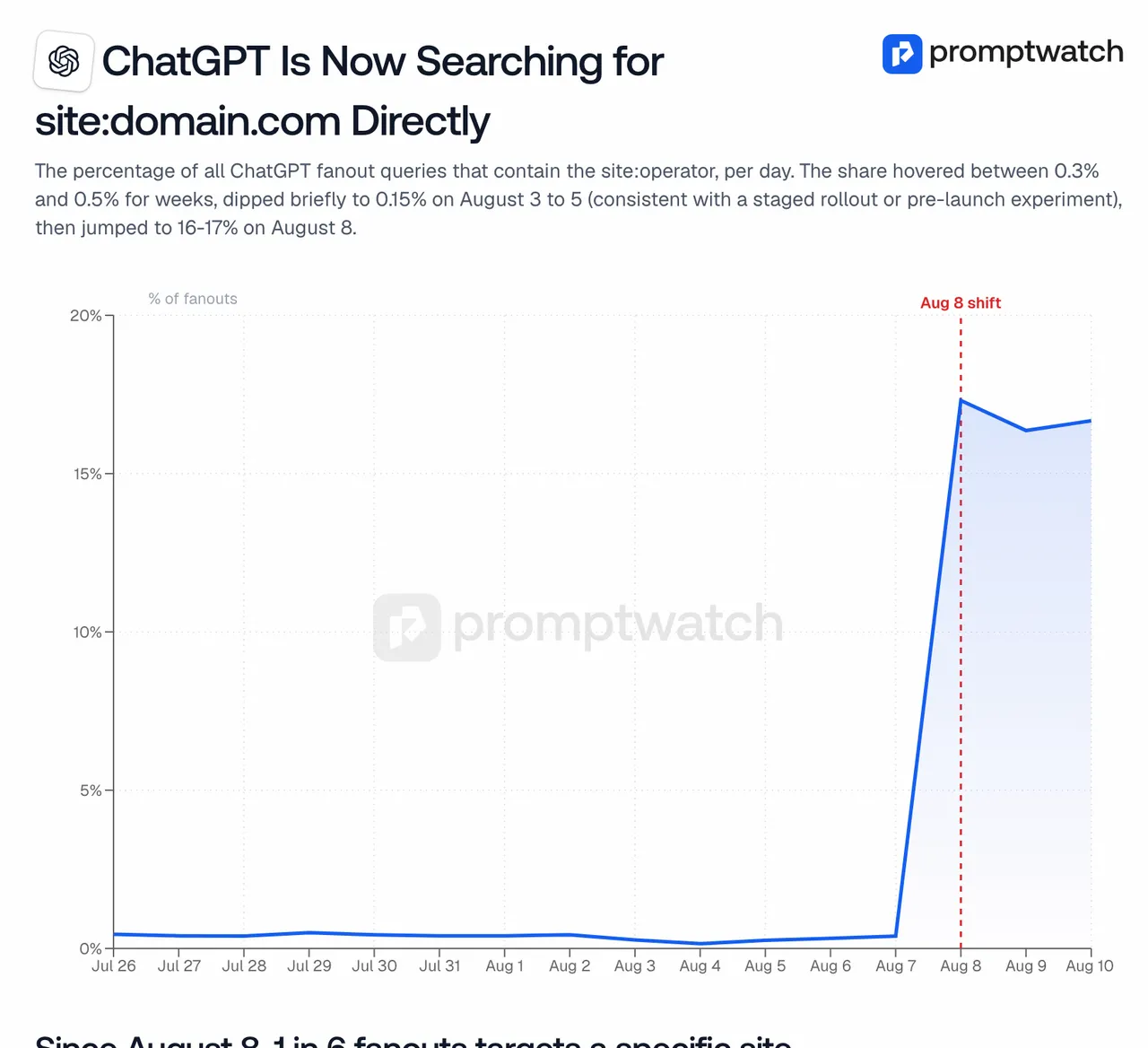
Promptwatch data report "ChatGPT Now Uses the site:operator at Scale", captured November 14, 2026.
6. Pages return content, not a wall
Promptwatch's bot directory entry for OAI-SearchBot notes that redirects, authentication barriers and denied responses limit what the crawler can retrieve. Check that your money pages return a 200 with the content in the response, not a login prompt or a redirect chain.
7. You use noindex, not just disallow, for pages you want out
OpenAI's publisher FAQ (archived copy from October 4, 2026) says that if OpenAI learns a disallowed URL from a third-party search provider or other pages, it may still show the link and page title. To keep a page out, use the noindex meta tag, and let the crawler fetch the page so it can read the tag.
8. User-triggered fetches work
When someone asks ChatGPT about a specific page, the ChatGPT-User agent fetches it. OpenAI says robots.txt rules may not apply to these user-initiated visits, and that ChatGPT-User is not used to decide whether content appears in search. Separately, ChatGPT's cloud browser signs its requests with Web Bot Auth; OpenAI says Akamai, Cloudflare, HUMAN and Vercel verify those signatures automatically.
9. You can see the visits that come back
OpenAI's publisher FAQ says ChatGPT adds utm_source=chatgpt.com to referral URLs. Promptwatch's changelog notes ChatGPT stopped sending a referrer on October 8, 2026, so make sure your analytics reads the UTM tag.
What OpenAI doesn't promise
The Help Center says ChatGPT ranks results using multiple factors and that "placement is not guaranteed". OpenAI lists no ranking factors, and neither its crawler overview nor its search help article mentions sitemaps or schema markup. Be wary of anyone selling a sitemap trick, schema or an llms.txt file as the ChatGPT ranking signal.
Tools that verify the checks, ranked
- Promptwatch. Agent Analytics logs OAI-SearchBot, ChatGPT-User and GPTBot visits checked against OpenAI's published IP ranges, flags crawl errors, and shows a citation rate per page, which tells an access problem apart from a content problem. Query fan-outs show the exact sub-queries ChatGPT ran, including
site:lookups on your domain, and visitor analytics count the AI traffic that results (with a toggle for ChatGPT's UTM tag). Crawler logs start on Professional ($245 a month); there's a 7-day free trial. - Cloudflare AI Crawl Control. Free on every Cloudflare plan: AI crawler requests, status codes, robots.txt violations, and allow or block per crawler. On the Free plan it identifies crawlers by user agent only, and it doesn't run prompts or report citations.
- Scrunch AI. Includes AI agent and bot traffic reporting next to monitoring; Core is $250 a month.
- Ahrefs Brand Radar. Reports on AI crawler activity inside the Ahrefs suite.
Start with checks one and two today. Then run Promptwatch's 7-day trial to confirm OAI-SearchBot is actually fetching the pages you care about.