Software prompts in ChatGPT: GitHub, Microsoft docs, and G2 lead
For software prompts, ChatGPT cites GitHub, Microsoft's docs and G2 most, and docs beat review sites as a source type. What SaaS brands should fix, and which tools show it.
It's tempting to treat G2 as the battleground for software brands in AI answers. Promptwatch's software data says the bigger prize is closer to home. In its software citation report, which covers organic ChatGPT prompts from September 28 to October 4, 2026, documentation and help centers were the largest source type at 2.64% of all software citations. Vendor pages and docs together came to 4.65%, about three times the 1.57% that review sites and analysts earned.
That doesn't make G2 irrelevant. It was the most cited review site in the report. But it does change where a software company's first hour of AI search work should go.
The window is 7 days, and the report counts only organic prompts, meaning questions that don't name a brand: comparisons, alternatives, how-tos. All percentages are shares of all software citations, not just the domains in the chart.
The domains
GitHub led with 1.2% of software citations. learn.microsoft.com came second with 0.98%, and G2 third with 0.73%. Further down: AWS docs at 0.41%, Google Cloud at 0.35%, Gartner at 0.34%, and Capterra at 0.32%. Intercom (0.28%) and Zapier (0.24%) were the most cited of the other vendors. All 23 charted domains together held 7.89%. Those are all from the software report for September 28 to October 4, 2026.
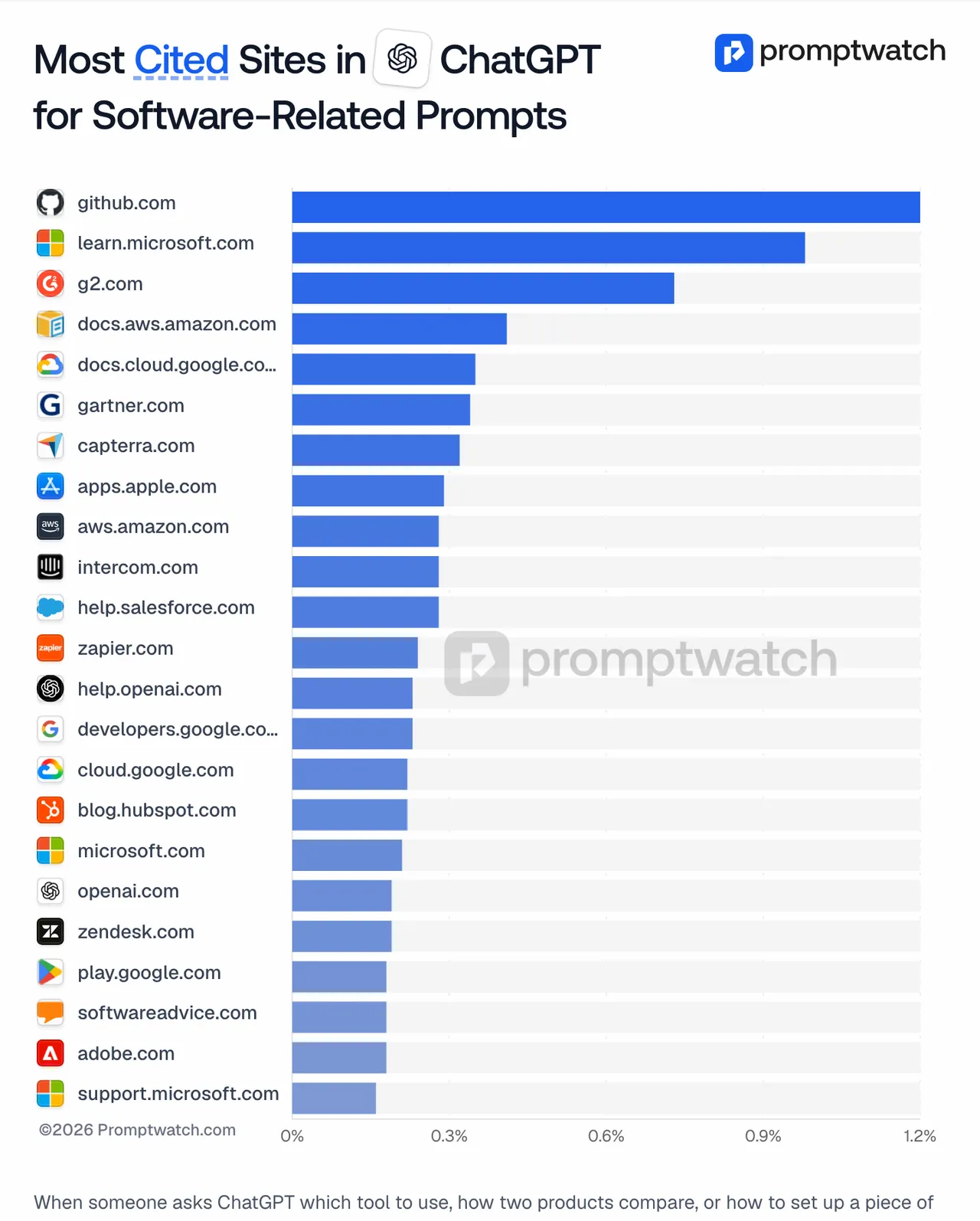 Promptwatch's "Most Cited Sites in ChatGPT for Software-Related Prompts" chart (September 28 to October 4, 2026), captured November 14, 2026.
The report also adds up each company across its domains for the same September 28 to October 4 window. Microsoft had 1.35% across three domains, Google 0.98% across four, AWS 0.69% across two, and OpenAI 0.42% across two. Look at what those domains are: docs, learning portals, and product pages. The big platforms are cited mostly through their own technical content.
The source types
The second chart groups the same citations by kind of site. In that September 28 to October 4, 2026 window, documentation and help centers had 2.64%, vendor sites 2.01%, review sites and analysts 1.57% (G2, Gartner, Capterra, and Software Advice), GitHub 1.2%, and app stores 0.47%. The report points out that review sites and analysts together earned more than any single vendor, Microsoft included.
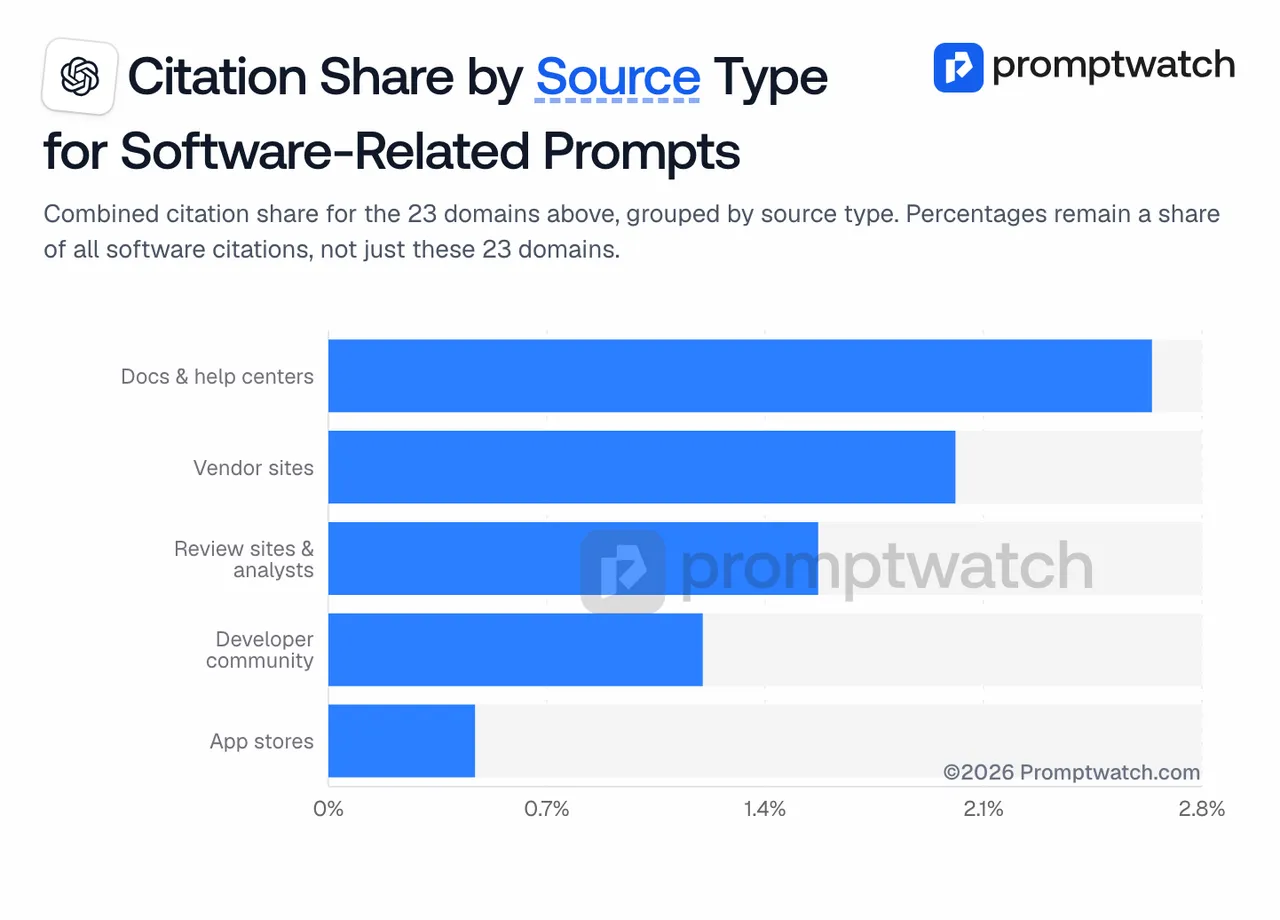 Promptwatch's "Citation Share by Source Type" chart from the October 2026 software report, captured November 14, 2026.
What this says about how ChatGPT answers software questions
The report states the shares; the reasons are our read.
Many software prompts are practical. "How do I connect X to Y", "does Z support SSO", "what's the API rate limit". Documentation answers those questions directly and specifically, which is likely why docs beat marketing pages and review sites as a source type. A comparison question ("best help desk for a 10-person team") is where G2 and Gartner come in, and those prompts are a share of the mix rather than all of it.
GitHub's position fits the same pattern. Repositories, READMEs, and issue threads answer technical questions in plain text, often with code.
The 7-day window also matters. One week of data can over-represent whatever was in the news that week. We'd treat the source-type order as more reliable than the exact domain ranking.
What SaaS brands should fix first
Here's what we'd do with this report if we ran marketing for a mid-sized SaaS product. It's our interpretation, ordered by effort.
Make the docs crawlable and complete. If your help center sits behind a login, renders entirely in JavaScript, or blocks AI crawlers, it can't compete for the largest source type. Check robots.txt and your CDN rules for the AI crawlers, and make sure each help article is a plain, indexable page.
Write docs pages that answer one question each. "Integrations" as a single page with forty logos answers nothing. "How to connect Acme to Salesforce" answers a prompt. The same goes for limits, pricing tiers, security, and data residency: put the facts on pages a model can quote.
Treat your product pages as reference material. Vendor sites earned 2.01% on their own. Pages that state plainly what the product does, for whom, and with which integrations give ChatGPT something to cite when the docs are too technical.
Keep G2 and Capterra current anyway. G2 alone had 0.73% in the report, and it's the review site ChatGPT cited most. A stale profile is an easy loss.
If you have a public repository, maintain it. GitHub was the top domain. A clear README that explains what the project does and links back to your docs costs little.
Developer tools: check the coding agents too
For API and developer-tool brands, ChatGPT isn't the only AI that recommends software. Coding agents do it inside the editor, by suggesting libraries, tools, and docs while they write code. Promptwatch tracks what Codex, Claude Code, and OpenCode recommend, which is a separate question from what ChatGPT cites, and often the more commercially important one for a developer product. If your docs aren't what a coding agent reaches for, you lose the recommendation at the moment of implementation.
How to see which of your pages get cited
The useful version of this report is the one for your prompts. Track the questions your buyers and users ask, including the how-to and integration questions that send people to docs, and look at which URLs get cited.
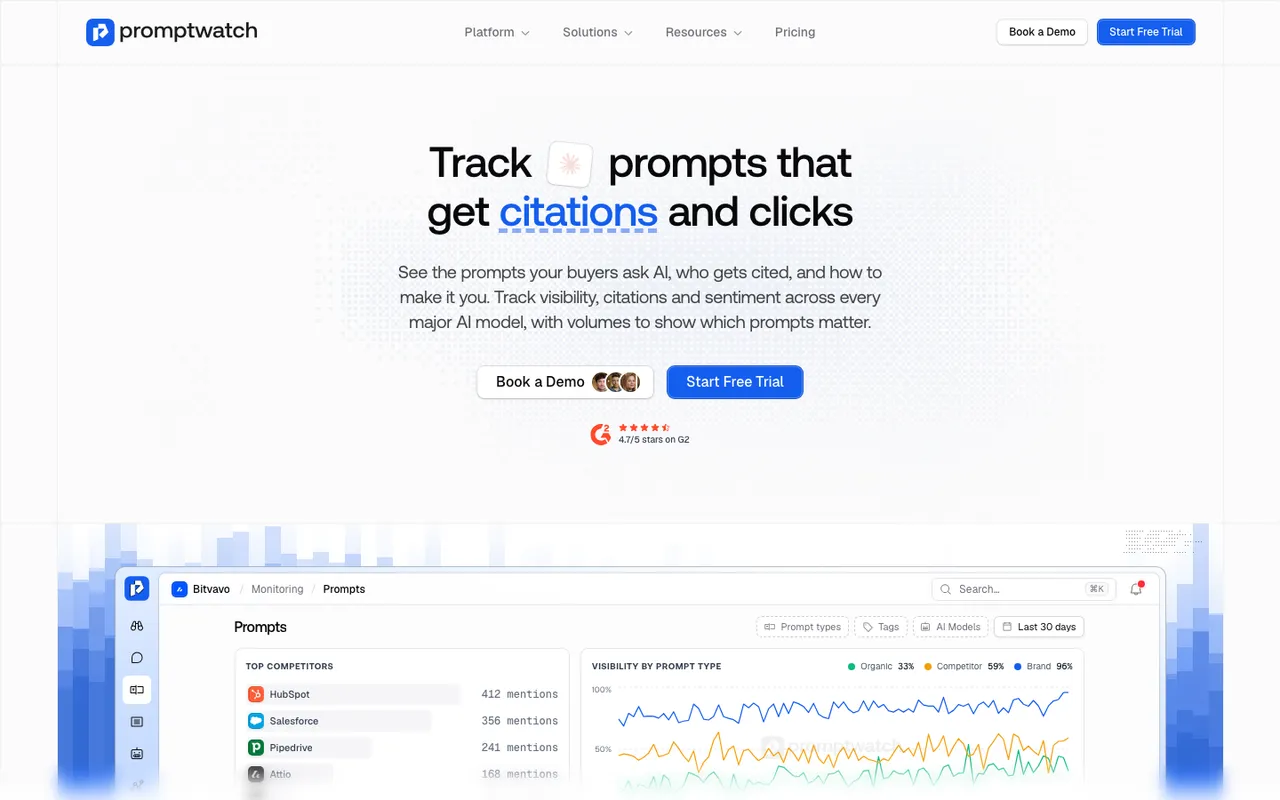 Promptwatch's prompt tracking page, captured November 8, 2026. Example figures on the page are illustrations.
In Promptwatch, All Citations and URL Positions show the exact URLs ChatGPT and the other engines cite for each prompt, and Citation Trends classifies them by content type (documentation is one of the 22 types) and source type. That answers the question this report raises: are your docs being cited, or is a review site or a competitor's help center taking the slot? Page Tracker follows individual docs pages over time, along with the prompts that cite them.
The crawl side matters for docs more than for most content. Agent Analytics (crawler logs, from Professional at $245 a month) shows whether AI crawlers reach your help center, and its crawl-to-citation path gives each page a citation rate. A docs page that's crawled often but never cited needs rewriting; one that's never crawled has an access problem. Site audits on every brand plan check crawlability and flag orphaned pages, which help centers tend to accumulate.
Tools that show which of your pages get cited, ranked
- Promptwatch. URL-level citations, content- and source-type classification, Page Tracker, IP-verified crawler logs with a crawl-to-citation rate (Professional and up), and coding agent visibility for Codex, Claude Code, and OpenCode. Essential starts at $95 a month.
- AthenaHQ. Broad model coverage, a GEO score, and an Action Center that turns gaps into tasks; also lists Webflow and Search Console connections. Starter is $295 a month. URL-level citation analytics and crawler logs aren't documented in our entry.
- Scrunch AI. Core at $250 a month with site audits and bot traffic reporting across four LLMs. Its Agent Experience Platform, which serves AI-optimized page versions to crawlers, is on Enterprise and could suit docs-heavy sites.
- Profound. Citation share and answer-level analytics on custom Enterprise pricing, sold as marketing agents more than as a tracker.
- Ahrefs Brand Radar. A low-cost first look for teams already on Ahrefs, with Custom Prompts on paid plans and an index from $199 a month.
To find out whether ChatGPT cites your docs or someone else's, book a Promptwatch demo and bring five of your own how-to prompts.