How often does ChatGPT change the sources it cites for the same question? Six causes, ranked
No official rate exists for how often ChatGPT swaps cited sources. We rank the six causes by impact, with OpenAI's documentation and dated Promptwatch citation data.
There is no published rate. OpenAI does not say how often ChatGPT changes the sources it cites when two people ask the same question, and no study in our source set measures run-to-run repeatability directly. What OpenAI does document is the machinery that makes citations move, and Promptwatch's public data reports put dates and sizes on the biggest shifts. Put together, the honest answer is: some sources can change between any two runs, a large share of cited pages drop out within weeks, and the whole citation mix can shift overnight when OpenAI changes its search behavior.
Below, the causes are ranked by how much each one can move your citations, from the largest to the smallest.
The six causes, ranked by impact
1. Platform-wide changes to how ChatGPT searches
The biggest moves are not about your page at all. Promptwatch's "ChatGPT Now Uses the site:operator at Scale" report found that on August 8, 2026, fanout queries containing site: jumped from 0.37% to 16.8% of all ChatGPT fanouts, and the average number of searches per response went from about 1.08 to about 1.83 the same day (chart window Jul 26 to Aug 10, 2026). When the questions ChatGPT sends to search change overnight, the pages it finds change with them.
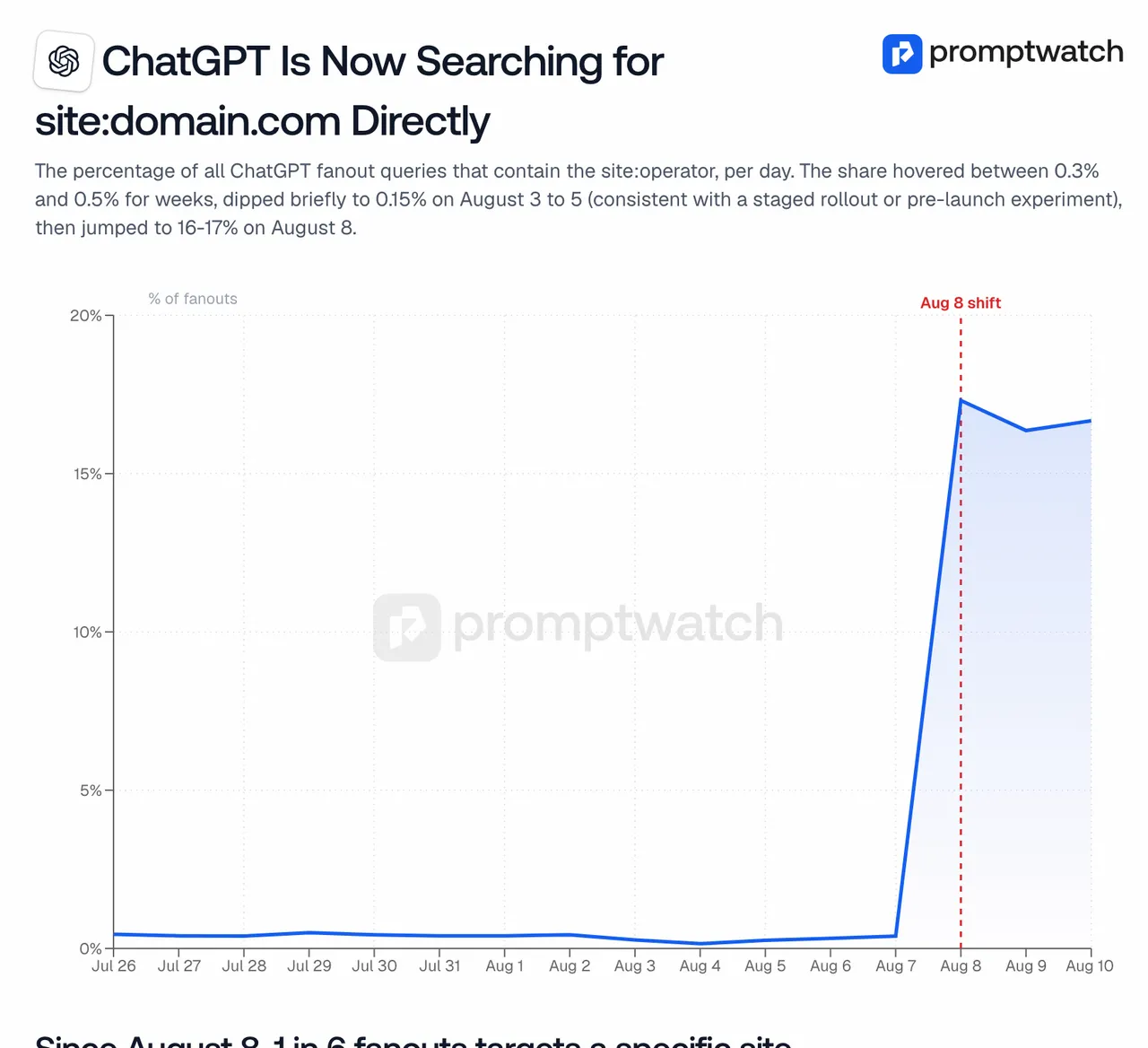
Promptwatch data report "ChatGPT Now Uses the site:operator at Scale", captured November 14, 2026.
2. Fewer citation slots per answer
Promptwatch's "ChatGPT Citation Drop After GPT-5.3" report measured about 6.4 sources per search-enabled response in the week before the March 4, 2026 rollout, and 4.7 to 4.9 by late March. That is roughly 27% fewer slots in every answer. When slots shrink, the marginal sources go first, even if nothing about them changed.
3. Query rewriting behind the answer
OpenAI's Help Center article "Searching the web with ChatGPT" explains that when ChatGPT search uses a search partner, it "typically rewrites your query into one or more targeted queries", and it may send further, more specific queries after reviewing the first results. Nothing in that article says the rewritten queries are identical from one run to the next, so two runs of the same question can search for slightly different things and land on different pages. Promptwatch captures those fanout queries per response, which is how you check whether that happened.
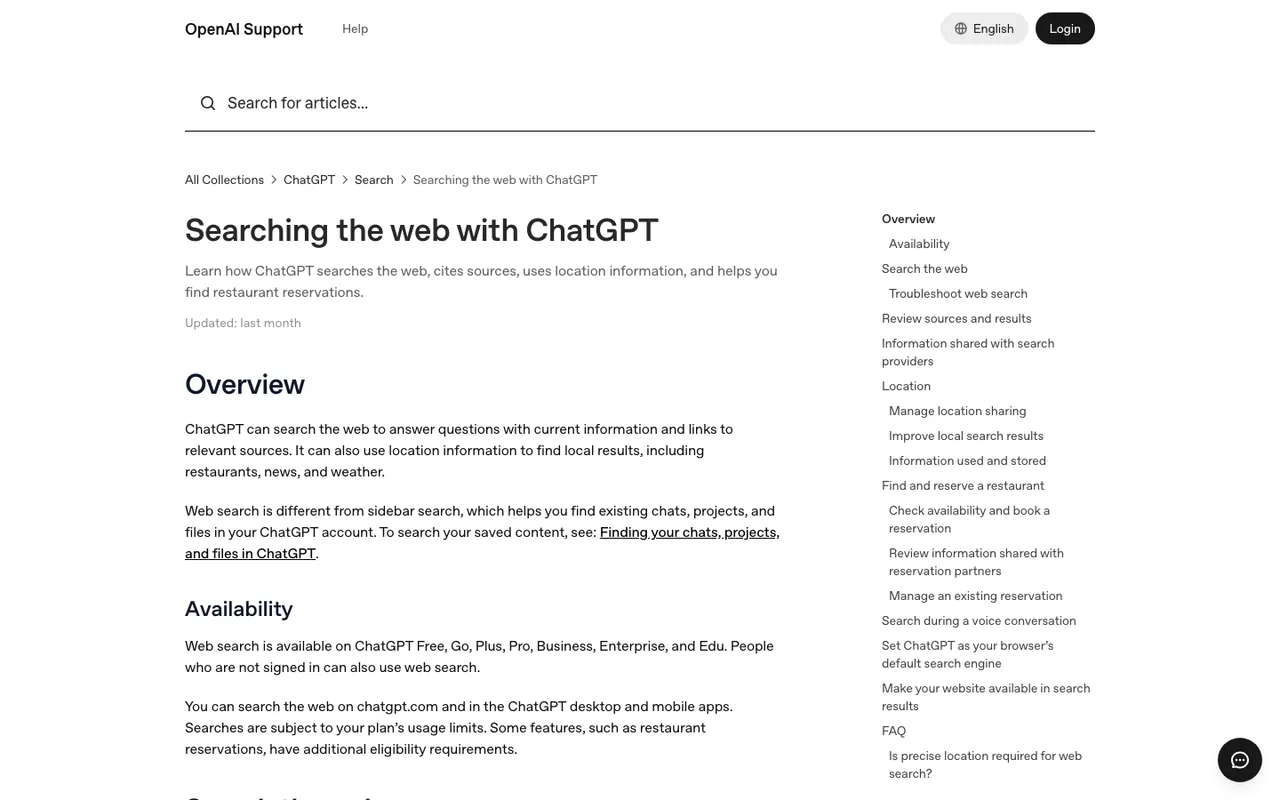
OpenAI Help Center, "Searching the web with ChatGPT", captured November 21, 2026.
4. Content decay
Pages lose their citations on their own schedule. Promptwatch's "What Is the Half-Life of Content in ChatGPT?" report followed every classified page ChatGPT cited on July 6, 2026 through October 4. Half of the news pages were no longer cited after 36 days, and almost a quarter were never cited again after day 0. Landing pages (78%) and docs (76%) were still cited at 30 days. Product pages, reviews and how-tos reached their half-life after 74 to 77 days.
5. Domain-level shifts in what ChatGPT trusts
Whole domains rise and fall. Promptwatch's monthly ChatGPT citation-share reports show Wikipedia falling from 3.63% of citations in January 2026 to 0.56% in June 2026 (June is month-to-date, Jun 1 to 27), with Reddit taking the top spot from April. Separately, the "Reddit Citations Are Dropping in ChatGPT" report measured Reddit at 3.83% of ChatGPT citations from Jul 18 to Aug 7, 2026 and 0.52% from Aug 14 to 17, a drop the report itself calls provisional.
6. Who is asking, and from where
OpenAI says ChatGPT uses approximate location from the user's IP address and may share general location with search providers. A question asked from Amsterdam and the same question asked from Chicago can therefore pull different local sources. This mostly matters for local and regional prompts.
What OpenAI does not say
OpenAI publishes no ranking factors beyond "ChatGPT ranks search results using multiple factors" and "Placement is not guaranteed." It doesn't say how often OAI-SearchBot recrawls a page or how long after a crawl a page can be cited. Any article giving you a precise churn percentage for ChatGPT is quoting its own sample, not OpenAI.
Tools that measure citation churn, ranked
- Promptwatch: re-runs tracked prompts daily on every plan, and every 12, 6 or 1 hours on Business. It captures the exact fanout queries behind each response, and its Citation Trends tab shows per-page first-cited date, ramp-up days, peak rate and decay half-life. Page Tracker follows specific URLs, yours or a competitor's. From $95/mo with a 7-day free trial.
- AthenaHQ: tracks citations across 11 models on Starter ($295/mo, 3,600 credits, one credit per AI response). Repeat runs consume credits, so budget for frequency.
- Scrunch AI: Core at $250/mo covers 125 prompts and 5,000 responses a month across four LLMs, ChatGPT included.
- Profound: its trial runs 50 prompts daily for 7 days across ChatGPT, Gemini and Google AI Overviews; Enterprise pricing is custom.
- Ahrefs Brand Radar: its AI Visibility Index question sets are retested monthly. That suits trend reading, but a monthly snapshot can't show run-to-run churn.
How to read your own churn
Track a fixed set of prompts for at least a month before drawing conclusions, and compare each drop against the dates above before blaming your content. If a cited page fades gradually, it is decay; if every page drops on one day, it is ChatGPT. Promptwatch shows both on the same timeline, which is the fastest way to tell them apart. Start with the 7-day free trial on monthly billing and add the five prompts that matter most to your pipeline.