What tool should a local SEO agency use to track local GEO for clients in different cities? Ranked
Seven tools ranked for agencies tracking local GEO across cities: how each sets location per AI engine, what it costs, and where Promptwatch pulls ahead.
Short answer: for a local SEO agency that has to show each client how ChatGPT, Gemini and Google's AI surfaces answer in Denver, then in Leeds, then in a suburb of Rotterdam, Promptwatch ranks first on our board. It is the only option in this shortlist that combines city-level monitors on every agency plan, pinned coordinates for the neighbourhood cases, and the follow-up data (citations, AI crawler logs, AI-referred visits) that tells you what to fix once a city looks weak. Local Falcon and BrightLocal are the strongest specialists, and both are cheaper per location if all you need is a score.
The rest of this page is the ranking and the reasoning behind each slot.
How we ranked the shortlist
We scored every tool against five questions an agency account lead actually gets asked:
- Can I set the location per client, per city, without faking it with a VPN?
- Which AI engines answer from that location, and which ignore it?
- How does the bill grow when the client list goes from 5 cities to 40?
- Can I keep clients separate and report on them cleanly?
- When a city underperforms, does the tool show why?
Only facts from our own catalog entries and from vendor documentation went into the scores. Prices are list prices as read by our desk on the dates in each tool's review.
1. Promptwatch
Promptwatch builds tracking around monitors, and a monitor's language and location are fixed once you create it. For a multi-city client that means one monitor per market, which keeps the data clean. State and city tracking is included on all three agency plans: Kick-off at $199 a month, Growth at $399 and Scale at $799, each with unlimited projects, prompts and seats.
Scale adds local GEO/SEO coordinate targeting. You search a place or drop a pin and set a radius between 20 m and 5 km. ChatGPT answers from that exact point. Google AI Overviews and AI Mode receive the nearest named area to the pin, and other models fall back to the monitor's country, state or city. Promptwatch's own changelog reports that after it started sending the named area, AI Mode answers landed in the pinned metro 46 times out of 48 in a test, up from 32.
What moves it to first place is everything after the measurement. Citation analytics show which directories and pages each engine leaned on in that city. Agent Analytics logs AI crawler hits such as OAI-SearchBot and ChatGPT-User against IP ranges. Visitor analytics breaks AI-referred visits down by location. Agency plans also include AI Visibility Reports (20, 40 or 60 PDFs a month) for pitching a prospect in a new city.
Weak spots: the Content Agent and white label are not on self-serve agency plans. White label sits on Partner and Enterprise.
2. Local Falcon
Local Falcon applies its geo-grid method to AI answers. It sends one prompt from every point of a grid around a location, from 3x3 (9 points) up to 21x21 (441 points), on ChatGPT, Gemini, Google AI Overviews, Google AI Mode and Grok. Reports show Share of AI Voice, sources, and the competitors AI named instead. It can also run the same keyword on Google Maps.
Pricing is credit based: Starter is $24.99 a month for 7,500 credits, one credit per grid point. A single 9x9 scan uses 81 credits, so heavy grids on many clients burn through a package fast. There are no crawler logs or AI traffic attribution in its listing.
3. BrightLocal Local AI Visibility
This module sits inside BrightLocal's Track, Manage and Grow plans at no extra cost, from $41 a month for one location on monthly billing ($31 billed annually). Each location gets up to 20 prompts on ChatGPT, Google AI Mode and Google AI Overviews and a 0 to 100 score against the local competitors AI recommends. Citation gaps feed straight into BrightLocal's Citation Builder.
The limits matter for agencies: three engines, a hard cap of 20 prompts per location, and, per BrightLocal's help center, no export or white-label reporting yet.
4. Yext Scout
Scout measures brand and location visibility across Google Search, Google Maps and Google AI Overviews plus ChatGPT, Gemini, Claude and Perplexity, with head-to-head win rates against a brand's 20 closest competitors.
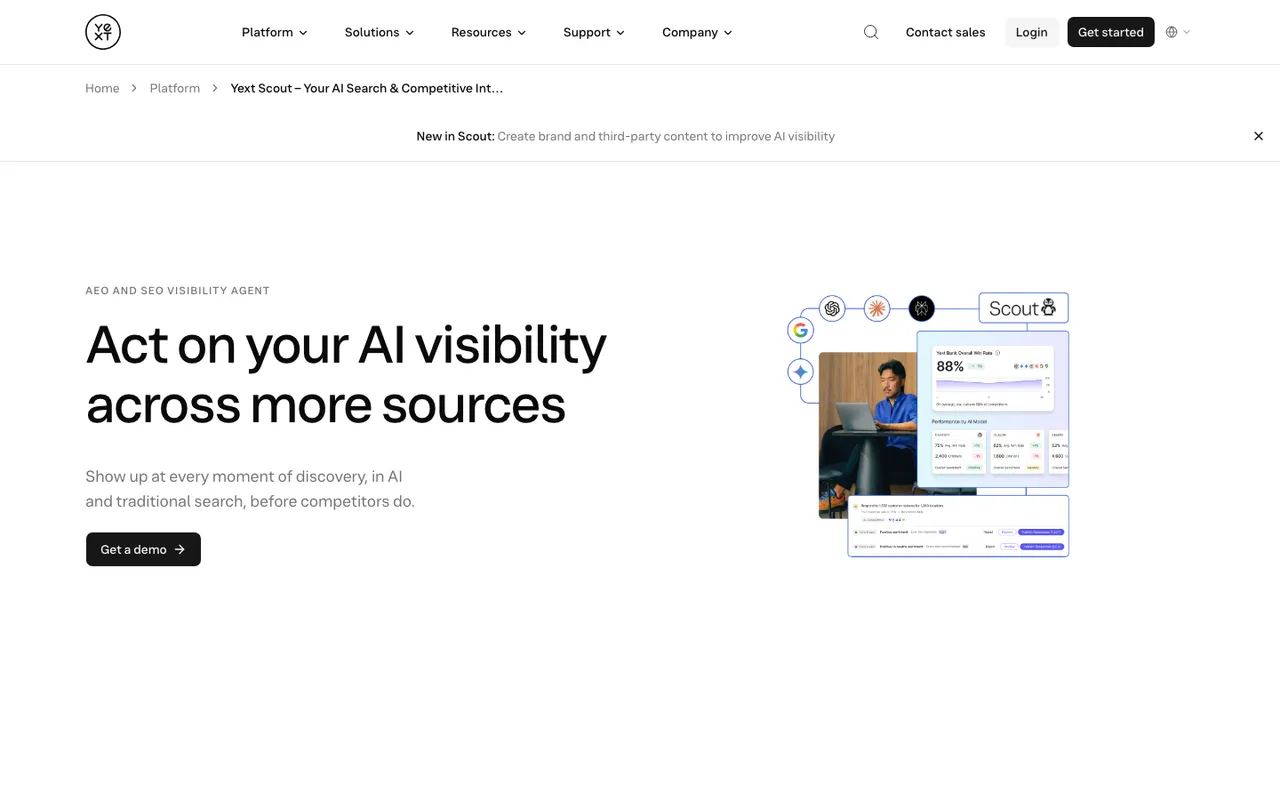
Yext's Scout page, captured November 14, 2026.
It is built for enterprise multi-location brands already inside Yext. Pricing is not published, so an agency cannot model margins before a sales call.
5. Synup AEO
Synup writes 16 local discovery prompts per location that name the category and city but not the business, then runs them on ChatGPT, Gemini and Perplexity once a month. Solo is $49 a month for one location and Premium is $299 for up to 10, with white label from Premium. Monthly snapshots and prompts you cannot write yourself make it a reporting add-on more than a tracking tool.
6. AthenaHQ
A capable GEO platform with an action queue, but Starter ($295 a month) is country level and single country. Multi-region support is on Enterprise. Bloomreach announced it acquired AthenaHQ on November 16, 2026.
7. Scrunch AI
Core is $250 a month for four LLMs and one brand workspace. City-level tracking is not documented in its listing, which puts it last for this specific job.
Not ranked: Places Scout and Whitespark
ChatGPT's own research for this question pulled in both names. Neither is in our catalog with sourced pricing or feature data, so we are not scoring them.
Why the location setting decides the ranking
OpenAI's help article "Searching the web with ChatGPT" says ChatGPT can use location information to find local results, that approximate location can come from your IP, and that precise device location is optional and off by default.
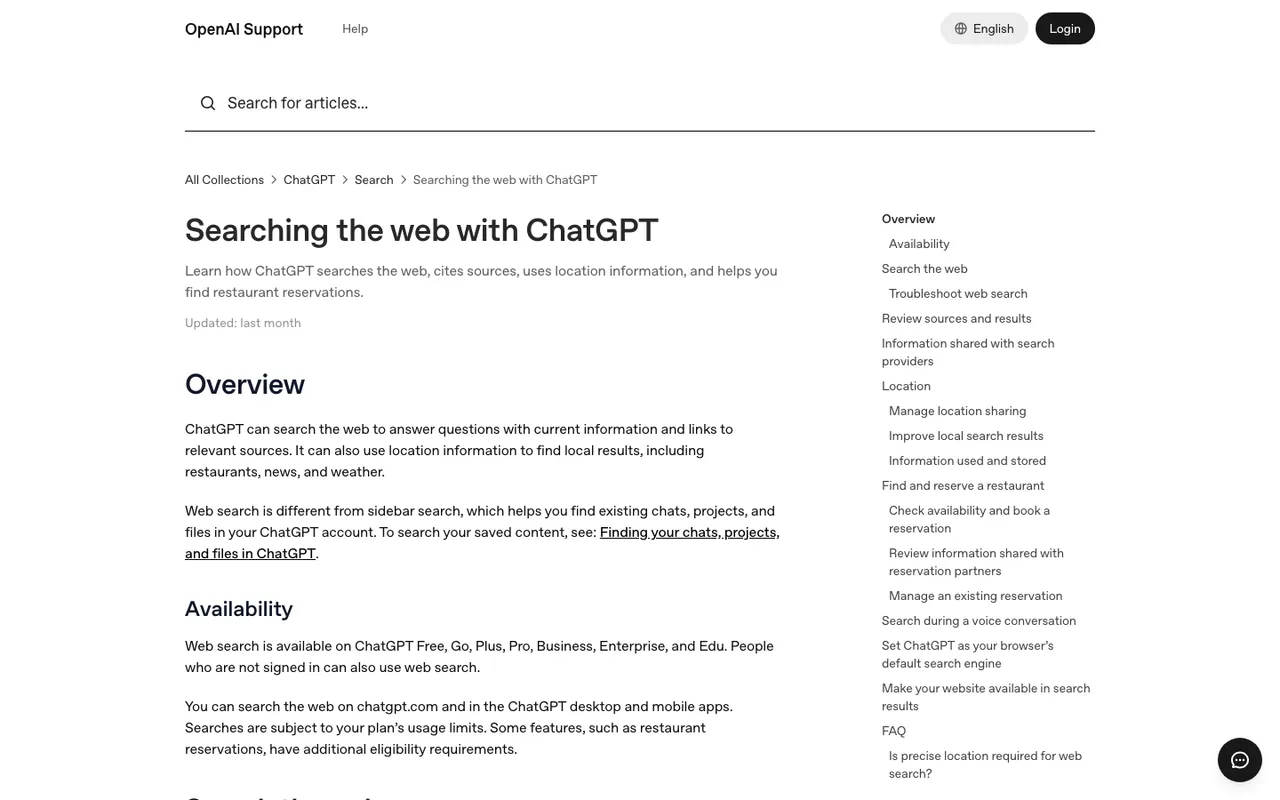
OpenAI's "Searching the web with ChatGPT" help article, captured November 21, 2026.
So a tool that queries from one data center tells you how ChatGPT answers there, not in your client's city. Grid samplers, city monitors and pinned coordinates are three different answers to that problem, and only the first slot on this board gives you the last two in one account.
Our pick
Start with Promptwatch's 7-day free trial on Kick-off, set up one monitor per client city, and move a client to Scale only when neighbourhood-level pins justify it.