What is agentic search and how does it change which content gets seen? Seven checks, ranked
Agentic search sends AI agents to run sub-queries, open pages and cite only a few. Seven visibility checks ranked by impact, plus the tools that measure each.
Agentic search is what happens when the answer engine does the searching for the user. Instead of returning ten links and letting a person click through, an AI system decides which searches to run, reads the pages that come back, sometimes opens a browser and clicks around, and then writes one answer that cites a handful of sources. ChatGPT search, Google AI Overviews and AI Mode, Perplexity, Claude and Meta AI all work some version of this loop.
For a site owner the consequence is blunt. Ranking on page one for the user's literal question matters less than whether your page turns up in the agent's own sub-searches, whether the agent's crawler is allowed to fetch it, and whether it earns one of the few citation slots in the final answer.
We ranked the checks below by how much each one decides whether your content gets seen. The first two are binary: fail them and nothing further down helps.
1. The search crawlers can reach your pages
Every engine has a crawler that builds the index its agent searches, and the rules differ per vendor. OpenAI's crawler overview says OAI-SearchBot is the bot that surfaces sites in ChatGPT's search features, and that sites opted out of it "will not be shown in ChatGPT search answers", though they can still appear as navigational links. GPTBot is a separate token for training, and OpenAI says the two settings are independent. Anthropic splits the same way with ClaudeBot for training and Claude-SearchBot for search quality. Perplexity says PerplexityBot surfaces and links sites and is not used to train foundation models.
A robots.txt line, a CDN bot rule or a WAF challenge aimed at "AI bots" in general can quietly remove you from these answers.
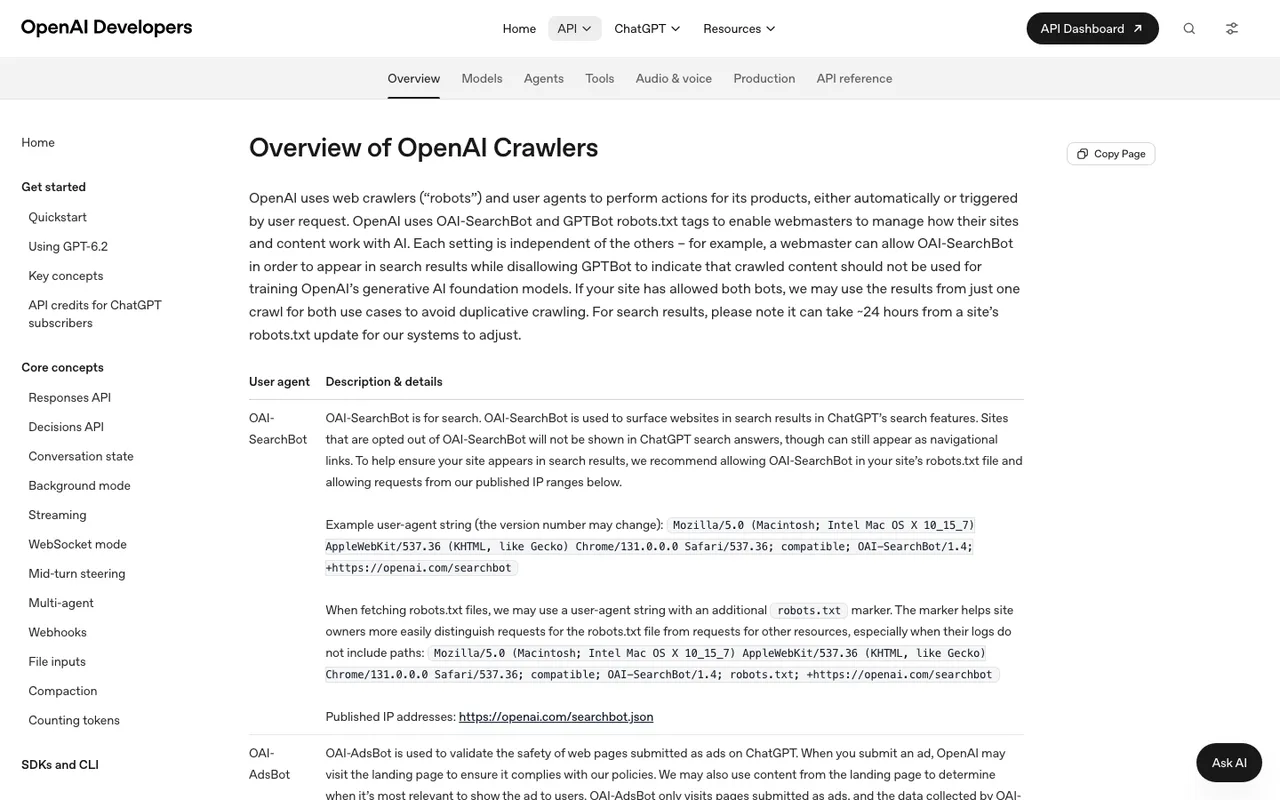
OpenAI's "Overview of OpenAI Crawlers" page, captured November 21, 2026.
2. You cover the sub-queries, not only the prompt
Google's "AI features and your website" page says AI Overviews and AI Mode "may use a 'query fan-out' technique", running several related searches across subtopics. OpenAI's help page on searching the web says ChatGPT typically rewrites a question into one or more targeted queries and may send more specific ones after reviewing results. The page that gets cited is the one that ranked for those hidden searches.
Promptwatch records query fan-outs per model, with the exact sub-queries behind each tracked response. That turns "improve AI visibility" into a list of searches you either win or lose.
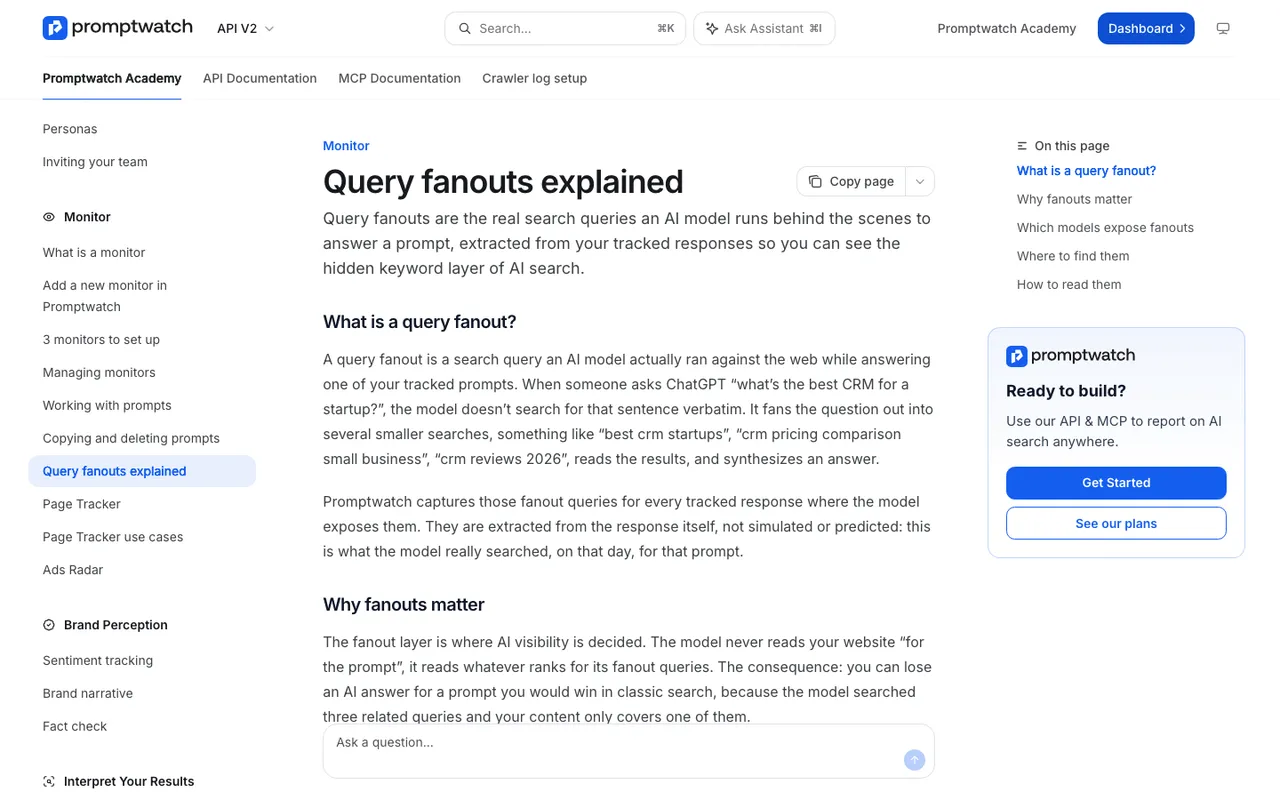
Promptwatch Academy, "Query fanouts explained", captured November 14, 2026.
3. Your own domain answers direct lookups
Agents now search inside specific sites. Promptwatch's data report "ChatGPT Now Uses the site:operator at Scale" found that on August 8, 2026, site: queries went from 0.37% to 16.8% of all ChatGPT fanout queries, and average fanouts per response rose from about 1.08 to about 1.83 the same day. A site: query can only return pages a search engine has indexed, so thin category pages and unindexed sections now cost answers.
4. You compete for very few citation slots
An agent reads many pages and cites few. Promptwatch's average-sources report puts ChatGPT at around five sources per web-search answer, against roughly ten for Google AI Overviews and almost exactly ten for Perplexity, in windows that end mid-June with no year shown. After GPT-5.3, the "ChatGPT Citation Drop After GPT-5.3" report measured about 6.4 sources per search-enabled ChatGPT response before the rollout and 4.7 to 4.9 by late March 2026.
5. Mid-authority pages are not shut out
Agentic search does not simply hand every slot to the biggest domains. In August 2026, sites with a domain rating of 46 to 75 earned 46% of ChatGPT citations, while DR 91 to 100 averaged 4.4% and fell to about 3% from August 14, according to Promptwatch's "ChatGPT Citation Share by Domain Rank" report for August 2026. A specialist page that answers the sub-query cleanly can win.
6. Time-sensitive pages get refreshed
Citations decay. Promptwatch's "What Is the Half-Life of Content in ChatGPT?" report found half of the news pages ChatGPT cited on July 6 were no longer cited after 36 days, while 78% of landing pages and 76% of docs were still cited at 30 days. In Promptwatch, Citation Trends shows first cited, ramp-up days, peak rate and decay half-life per page, so you can see which of your pages are fading.
7. Agent visits and AI traffic are measured
Some agent traffic never shows up as a crawler. OpenAI says ChatGPT-User visits a page when a user asks a question and that robots.txt rules may not apply to it. Google says its user-triggered fetchers, Google-Agent included, generally ignore robots.txt. On the referral side, Promptwatch's changelog notes ChatGPT stopped sending a referrer on October 8, 2026, and its visitor analytics added a toggle that counts utm_source=chatgpt.com visits as ChatGPT again.
Tools that measure these checks, ranked
- Promptwatch: covers all seven. IP-verified crawler logs with a crawl-to-citation path and citation rate per page (from Professional, $245 a month), query fan-outs per model, citation analytics, and visitor analytics with conversions. Essential starts at $95 a month without crawler logs.
- AthenaHQ: tracks AI answers and turns gaps into tasks through an Action Center. Starter is $295 a month. Bloomreach announced it acquired AthenaHQ on November 16, 2026. No crawler-log product is published.
- Scrunch AI: monitoring plus AXP, which serves AI-optimized page versions to LLM crawlers. Core is $250 a month for four LLMs; AXP sits on Enterprise.
- Ahrefs Brand Radar: AI visibility inside an Ahrefs plan, with crawler activity reporting. The AI Visibility Index starts at $199 a month.
- Profound: now sold as an AI Marketer with agents for research and content. Enterprise is custom, with an earlier estimate of about $40k a year.
If you want to run the seven checks on your own site, start Promptwatch's 7-day free trial on monthly billing and begin with the crawler logs and the fan-out view.